Author Archives: pressure


Warning: Undefined variable $theme_options in /home/r8097536/public_html/pressurecooker.pro/wp-content/themes/colorful-theme/author.php on line 62

Warning: Trying to access array offset on null in /home/r8097536/public_html/pressurecooker.pro/wp-content/themes/colorful-theme/author.php on line 62

Cut Prep Time to One-Quarter! The Fastest Scientific Approach to Perfect Tonkotsu Broth – From Silky Clear to Ultra-Rich

Tonkotsu broth holds an unrivaled place in the ramen world. Yet extracting that powerful richness and umami from bones using a conventional stockpot places an enormous burden on the kitchen. The relentless work of boiling at full blast for over ten hours, cracking bones, and continuously stirring is, in an era of soaring gas prices and severe labor shortages, the single most urgent “heavy labor cost” that ramen businesses must address.

In this article, we explain why a commercial pressure cooker (boiling point: 120°C / 248°F) can cut your prep time to one-quarter of the traditional method – and the scientific approach to achieving any tonkotsu broth you want at maximum speed, from a light, silky Hakata-style clear broth to a thick, ultra-rich paitan.

The Challenge of Tonkotsu Broth: Why Does a Standard Stockpot Take 10+ Hours?

The physical process of extracting rich broth from pork bones is fundamentally about “breaking down the hard calcium structures of the bone and drawing out the marrow, collagen, and fat to the absolute limit.”

At 100°C, You Can’t Break Through “The Bone Wall”

A standard stockpot (100°C / 212°F) simply lacks the kinetic energy of water molecules to dissolve tough bone structures – such as knuckle bones (femur) – except very slowly from the outside. As a result, extracting the umami compounds deep inside the bone (inosinic acid and glutamic acid) and the collagen that creates richness requires a painstaking 10 to 15 hours.

The Battle Against Constant Stirring and Scorching at the Bottom

The richer the broth you aim for, the higher the viscosity (Brix value) rises. In a standard stockpot, bone fragments and connective tissue that sink to the bottom sit directly over the flame and scorch – forcing staff to scrape the bottom with a heavy wooden paddle every few minutes. This is the single greatest cause of shift overload and physical exhaustion for kitchen staff.

The Process of Maximum-Speed, High-Concentration Extraction with a Pressure Cooker

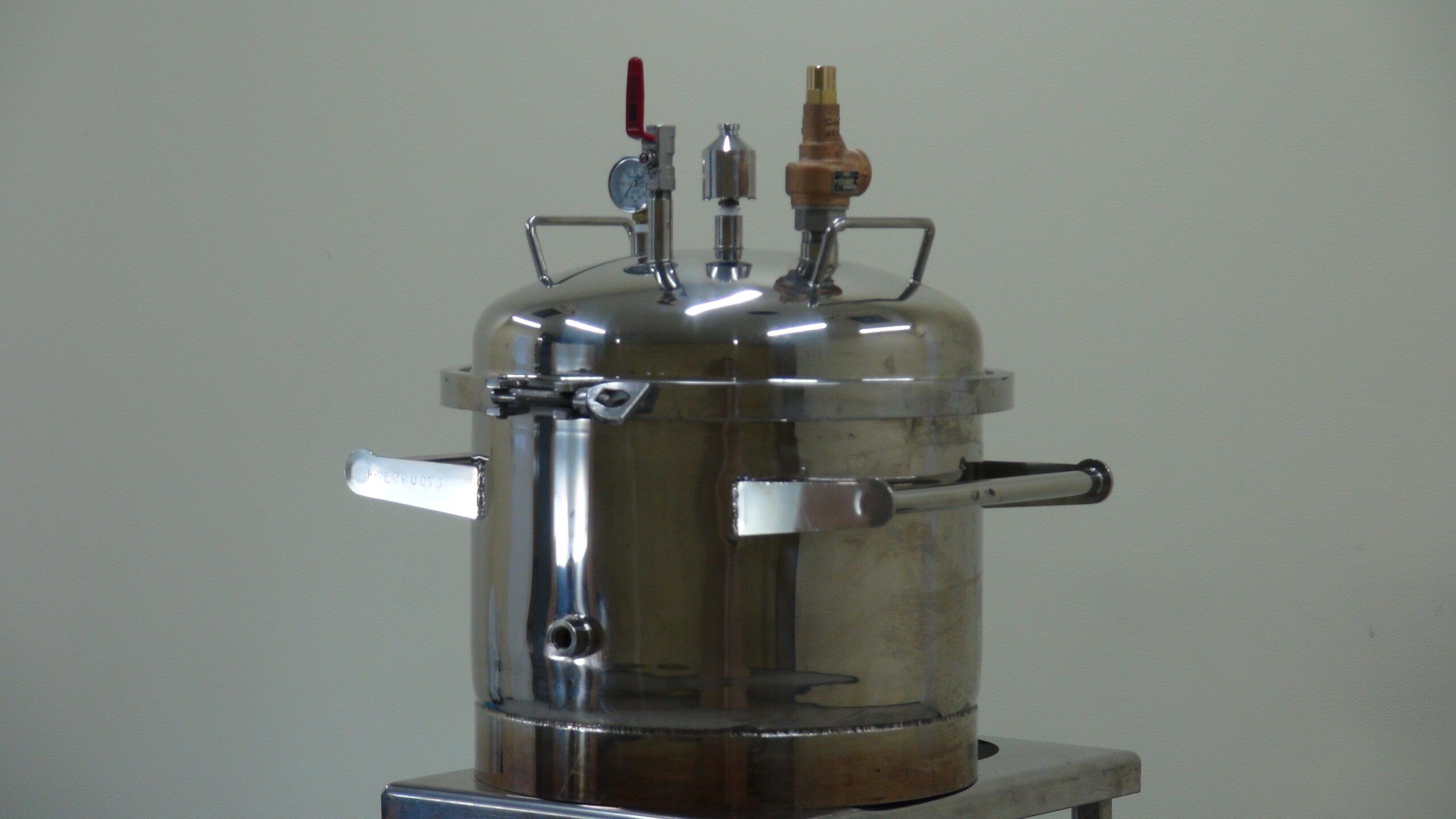
When you introduce a commercial pressure cooker (50L to 130L models), “the 10-hour wall” collapses instantly. Let’s walk through the prep process on a timeline.

How Bones Crumble to Sand in Just 90 to 120 Minutes

Inside a pressure cooker, applying pressure of up to 0.15 to 0.3 MPa raises the internal temperature to 120°C or above.

Simultaneous Penetration and Breakdown: The superheated, high-pressure water at 120°C penetrates instantly through the microscopic gaps in the bone all the way to the inner marrow.

Accelerated Softening: The calcium bonds in hard bone loosen rapidly, and the softening and fragmentation process that took 10 hours in a standard stockpot is completed in just 1.5 to 2 hours (90 to 120 minutes). When you open the lid after cooking and prod the bones, they crumble away as soft as sand – soft enough to dispose of as regular waste.

The Double-Layer Basket Eliminates All Stirring Labor

Meiwa Seisakusho’s pressure cookers come standard with a stainless steel inner pot (punching basket) that holds all the ingredients.

Since bones and meat never come into contact with the outer pot bottom – where the flame directly applies – there is absolutely no scorching, no matter how rich and concentrated the broth becomes during cooking.

Therefore, zero stirring is required during cooking. Once the ingredients are loaded and the lid is closed, cooking proceeds completely automatically until the timer sounds.

[By Recipe] Controlling Pressure and Time to Achieve Any Broth – From Silky to Ultra-Rich

You may have heard the misconception that “a pressure cooker always produces a thick, heavy broth.” That is incorrect. By controlling the pressurization time and the depressurization procedure (valve operation), a pressure cooker can produce tonkotsu broth of any concentration you desire.

Approach 1: Hakata-Style Light, Silky Emulsified Broth

This approach creates a broth with a clean umami flavor and just a hint of tonkotsu richness – endlessly drinkable and never overpowering.

Ingredients: Built primarily around head bones and back carcass (seigara).

Pressure Control: Set pressure slightly lower (0.13 to 0.15 MPa), with a short pressurization time of 45 to 60 minutes. Stop at the precise moment before the bones are fully pulverized.

Finishing Procedure: After switching off the heat, release steam slowly through the valve for natural depressurization. By avoiding violent internal convection (boiling), the fat does not over-emulsify, resulting in a clear, lightly emulsified broth with a smooth, translucent quality.

Approach 2: Classic Iekei-Style Creamy Rich Tonkotsu Soy Broth

This approach creates a mellow broth with just the right viscosity – one that clings beautifully to soy tare and chicken oil (chāyou).

Ingredients: A balanced combination of knuckle bones (genkotsu) and back carcass.

Pressure Control: Apply firm pressure (0.15 to 0.2 MPa) with a pressurization time of approximately 90 minutes. Fully gelatinize all the collagen.

Finishing Procedure: After cooking, connect the dedicated liquid transfer hose and use the residual internal pressure to push the broth out in one go. As the broth passes through the valve, the powerful shear force breaks down the water, fat, and gelatin into extremely fine particles – producing a completely emulsified, creamy broth far smoother than anything achievable by hand, automatically.

Approach 3: Ultra-Rich, Thick Tokuno Tonkotsu / Tsukemen Broth

This approach produces a broth of overwhelming impact – with marrow fully dissolved and a Brix value (concentration index) exceeding double digits.

Ingredients: Knuckle bones as the main ingredient, with a large quantity of pig trotters and back fat added.

Pressure Control: Apply the series’ maximum pressure (0.3 MPa for the 50L model, 0.2 MPa for the 90L model) and pressurize for 120 minutes or more. Transform all marrow and cartilage into a fully dissolved, thick liquid.

Finishing Procedure: Open the pressure release valve all at once, causing the contents of the pot to flash-boil instantly. This explosive convective energy drives massive amounts of back fat and bone marrow into the broth to the absolute limit – producing an ultra-rich broth thick enough to keep a ladle upright. Thanks to the double-layer structure, there is zero scorching even at this extreme concentration.

Real Business Numbers from Shop Owners Who Transformed Their Tonkotsu Prep

The “fastest approach” to tonkotsu broth using a pressure cooker dramatically transforms a shop’s profit structure. Here are the actual improvement figures for a typical ramen restaurant (approximately ¥4M monthly revenue) that introduced the 90L model.

Labor Hours: A Reduction of 180 Hours Per Month

Before: 10 hours of daily prep (requiring constant supervision and stirring).

After: The pressure cooker runs for 2 hours. Actual hands-on time is just a total of 1 hour for preparation and cleanup.

Result: The 210 hours per month of prep labor (7 hours per day) plummeted to just 30 hours. The reclaimed time goes directly to the owner’s rest, new menu development, or reduced part-time staff shifts (labor cost cuts).

Energy Costs (Gas): A Monthly Reduction of 45% to 50%

With a standard stockpot, you need to run a massive burner at high-to-medium heat for 10 hours. With a pressure cooker, you bring it to a rapid boil in the first 20 to 30 minutes to build pressure, then simply leave it on low heat for the remaining 90 minutes. The sealed interior maintains 120°C even on low heat, so gas consumption drops by nearly half. In today’s environment of rising costs, this reduction in fixed expenses directly boosts a shop’s profit margin.

Conclusion: Draw Out Your Ideal Tonkotsu Broth in the Smartest Way Possible

“Tonkotsu broth only becomes delicious when you give it time” – that is merely nostalgia from an era before modern technology. What you truly need is to deliver 120°C of thermal energy to the bones, and the commercial pressure cooker is what achieves that in the shortest time possible.

Cut prep time to one-quarter, halve your gas costs, and produce an ideal tonkotsu broth that is richer than ever and absolutely consistent every single day. This smart approach to kitchen management is the new standard for ramen restaurants competing in today’s fiercely competitive market.

If you want to know “for my shop’s tonkotsu recipe, how many minutes will it take to achieve a certain broth?” – come experience it for yourself at Kitchen Techno’s test kitchen. We will demonstrate the fastest tonkotsu broth production live, using the bones you bring.

Warning: Undefined variable $theme_options in /home/r8097536/public_html/pressurecooker.pro/wp-content/themes/colorful-theme/author.php on line 62

Warning: Trying to access array offset on null in /home/r8097536/public_html/pressurecooker.pro/wp-content/themes/colorful-theme/author.php on line 62

Why 120°C? The Science Behind Pressure Cooking’s Dramatic Umami Enhancement

Ramen broth-making is not merely a matter of a chef’s intuition — it is a continuous series of precise chemical reactions. Simmering bones for hours is, at the molecular level, nothing other than the work of efficiently “extracting” umami compounds and lipids from bones and meat into water, then “binding” (emulsifying) them together.

Why does switching from a conventional stockpot (boiling point 100°C) to a commercial pressure cooker (boiling point 120°C+) so dramatically increase broth umami and create a smoother mouthfeel? Here we unravel that secret from the perspectives of thermodynamics and food science.

The Critical Difference Between 100°C and 120°C: An Explosive Change in Molecular Motion

No matter how powerful the heat source, water in an ordinary kitchen at atmospheric pressure will not rise above 100°C. However, by sealing the interior of a commercial pressure cooker and raising the internal pressure to its limit, it becomes possible to push water’s boiling point above 120°C. A mere 20-degree gap — yet the impact at the molecular level is dramatic.

Thermodynamics: “Molecular Collision Frequency” Skyrockets

Temperature is a measure of the intensity of thermal motion within a substance’s molecules. As temperature rises from 100°C to 120°C, the speed (kinetic energy) of water molecules increases explosively.

Enhanced Penetration: Rapidly moving water molecules instantly penetrate even the deepest micro-structures within pork bones and chicken carcasses.

Increased Destructive Force: Water molecules colliding with the cell walls and tissues of bones at extreme speed are able to physically break down and decompose internal bone structures that conventional stockpots could not destroy even after several hours.

Science-Proven Ultra-Fast, High-Concentration Extraction of Umami Compounds

At the heart of what makes ramen broth delicious are amino acid “glutamate” and nucleotide “inosinate” released from meat and bones. A 120°C environment maximizes the extraction efficiency of these components.

Maximizing “Umami Synergy” in a Short Time

In food science, it is well known that when glutamate (found in kombu and vegetables) and inosinate (from pork, chicken, and seafood) meet in a broth, an “umami synergy effect” occurs — the perceived umami intensity is several to more than ten times stronger than either compound alone.

The “Time-Saving” Advantage That Protects Glutamate from Heat Destruction

In fact, glutamate — the very source of umami — has a weakness: it is sensitive to heat. When simmered slowly for 10–15 hours in a conventional pot, the glutamate that has been extracted gradually breaks down (heat degradation) over time.

With 120°C pressure cooking, all compounds are drawn out at once in a short time (1.5–2 hours) before heat degradation can occur, so the components remain intact and the overall glutamate concentration in the broth is maintained at a very high level.

Pushing Inosinate from Bone Marrow to Its Absolute Limit

The marrow at the center of pork knuckles is packed with inosinate and lipids that form the base of rich, deep flavor. In a conventional 100°C stockpot, it takes enormous time for heat to penetrate through the bone’s hard calcium layer to reach the marrow. In a 120°C high-pressure environment, the bone is literally “pulverized,” allowing every last drop of marrow umami to dissolve into the broth in an instant.

The Mechanism of Collagen “Gelation” and “Auto-Emulsification”

The signature viscosity and creaminess of rich-style ramen — tonkotsu and chicken paitan — are also the product of chemical changes brought about by 120°C high temperature and pressure.

Ultra-Fast Conversion of Hard Collagen into Supple “Gelatin”

Collagen — abundantly found in pig trotters, pig skin, and chicken carcasses — has a rigid triple-helix structure that does not dissolve in water naturally. Converting it into the water-soluble polymer “gelatin” (hydrolysis) requires a large amount of thermal energy.

At 100°C, this decomposition takes an almost unimaginable amount of time. But once 120°C is reached, the collagen structure rapidly undergoes thermal dissociation and dissolves into the broth before your eyes. This gives the broth overwhelming body (thickness) and the supreme, lip-coating viscosity that defines great ramen.

Auto-Emulsification: Miraculously Merging Water and Oil

By nature, water and oil (pork lard, chicken fat) do not mix. To create a creamy, smooth paitan broth, you need to achieve “emulsification” — a state in which oil is dispersed as minute particles throughout water.

The Limits of “Physical Agitation” in a Conventional Stockpot

In a conventional stockpot, chefs forcibly break up bones with a rod and boil the stock vigorously on high heat for hours, using that physical energy to force emulsification. This is exhausting labor, and the moment the heat is reduced, water and oil tend to separate again — an unstable emulsion.

The “Ultra-High-Density Natural Emulsification” Created by 120°C Pressure

Inside a pressure cooker, gelatin (which acts as a natural emulsifier) dissolves out in large, concentrated quantities under 120°C heat. Furthermore, when pressure is suddenly released or when the soup passes through a dedicated valve during transfer, a powerful shear force acts within the broth. As a result, oil particles are broken down to their absolute limit and firmly bonded with gelatin, producing an extremely fine, high-density emulsified broth that never separates — completely automatically, with no human intervention required.

Side Benefits of 120°C Cooking: Eliminating Bitterness and Off-Odors

“Won’t cooking at high temperatures for a short time also bring out unpleasant bitterness and off-odors from the bones?” is a concern shared by many professionals. But from the perspective of food hygiene science, the result is actually the opposite.

High-Temperature Sterilization Cleanses Unwanted Flavors

Small amounts of blood and organic matter remaining on bone surfaces oxidize with prolonged heating, becoming the source of characteristic fishiness or bitterness. The 120°C high-temperature, high-pressure environment instantly thermally decomposes and denatures these odor-causing compounds. At the same time, the powerful sterilization effect of 120°C prevents off-flavors from oxidation before they can develop, resulting in a smooth broth in which only the ingredient’s own pure, clean umami comes to the fore.

Summary: Broth-Making with Thermodynamics on Your Side

A broth simmered with great care for 10 hours is delicious — but not because “time” itself worked any magic. It is simply the result of chemical changes — extraction of compounds and emulsification — that took all that time to finally achieve.

The environment of “120°C and high pressure” realized by a commercial pressure cooker is the scientifically optimal solution for reproducing those chemical changes at the ideal speed and highest concentration. By harnessing thermodynamics — the laws of physics — broth quality improves dramatically and consistently.

If you would like to actually taste a broth that has evolved scientifically, please visit Kitchen Techno’s test kitchen. You can experience for yourself the overwhelming umami concentration that 120°C brings — something that conventional stockpots simply cannot achieve.


Warning: Undefined variable $theme_options in /home/r8097536/public_html/pressurecooker.pro/wp-content/themes/colorful-theme/author.php on line 62

Warning: Trying to access array offset on null in /home/r8097536/public_html/pressurecooker.pro/wp-content/themes/colorful-theme/author.php on line 62

Is Long-Hour Cooking Outdated? The Kitchen Work Style Reform Saving Ramen Restaurant Management

Commercial Pressure Cooker
Table of Contents (click to open)

While Japanese ramen culture enjoys global popularity, domestic ramen restaurant management faces unprecedented challenges: rising ingredient costs, soaring energy bills, and above all, severe labor shortages and the harsh physical demands of broth preparation.

The tradition of simmering broth for 24 hours — once the badge of a thriving ramen shop — has become a fatal business risk. This article explains how the “kitchen work style reform” and commercial pressure cookers offer a path forward for ramen restaurant management in the modern era.

The Heavy Prep Work Problem and Business Risks Facing Ramen Restaurants

The biggest challenge for ramen restaurant owners is the “time” and “physical burden” of broth preparation. Rich broths like tonkotsu and tori paitan present three major risks in today’s labor environment.

Difficulty Recruiting and High Staff Turnover in a Labor-Short Era

Ramen restaurant prep starts hours before opening, sometimes in the middle of the night or early morning.

  • Normalized late-night and early-morning shifts
  • Standing work in a scorching kitchen
  • Hours of constant stirring and skimming

These conditions are the primary reason job postings attract few applicants. Staff who do get hired often quit early due to physical demands. Relying on skilled artisans creates a constant risk: when that person leaves, the restaurant can no longer maintain its signature flavor.

Ballooning Labor Costs from Long Working Hours

As labor compliance standards tighten, long staff hours translate directly into ballooning overtime costs. Having staff arrive hours early just for prep can cost several million yen per restaurant per year, significantly squeezing profit margins.

The Limits of Conventional Stock Pots for Broth Simmering

Why has prep become such heavy labor? The root cause lies in the physical limitations of the conventional stock pot (zundo) that restaurants have long taken for granted.

The 100 Degrees Celsius Limit: Time Needed to Extract Bone Umami

No matter how strong the flame, a conventional stock pot under atmospheric pressure cannot exceed 100 degrees Celsius internally.

To fully break down pork bones and chicken carcasses (marrow and collagen) and extract all their umami, 100 degrees requires 10 to 15 hours of simmering.

More time means continuously consuming both manpower to monitor the flame and gas.

Skilled Techniques Required: Stirring, Skimming, and Straining

Making broth in a conventional pot is not as simple as setting it on the heat and walking away.

Preventing scorching on the bottom: Rich broths cause bone and meat fragments to settle and burn. Staff must constantly stir vigorously from the bottom with a heavy metal spatula.

Skimming and straining: Carefully removing impurities to prevent off-flavors, then straining bones from broth using large colanders after completion, is grueling physical labor with a real risk of burns.

The Commercial Pressure Cooker: A Solution for Kitchen Modernization

The modern commercial pressure cooker solves these challenges of time, manpower, and cost through equipment innovation rather than sheer determination.

The Science of 120 Degrees Celsius Boiling Point from Sealed Construction

Commercial pressure cookers feature a fully sealed lid that raises the internal pressure (0.13MPa to 0.3MPa).

Higher cooking temperature: As pressure rises, the internal boiling point increases to approximately 120 degrees Celsius or higher.

Dramatically shorter cooking time: At 120 degrees and high pressure, heat transfer to ingredients speeds up dramatically. Tonkotsu broth that previously required 4 to 6 hours (sometimes 12 or more) is reduced to just 1.5 to 2 hours — effectively compressing cooking time to one-quarter of what it was.

Complete Automation Through Double Structure and Automatic Emulsification

The latest commercial pressure cookers manufactured by Meiwa Seisakusho incorporate advanced features to reduce on-site burden to zero.

Complete Prevention of Burning with Perforated Inner Pot

A stainless steel inner pot (basket) with countless holes is set inside the cooker in a double-structure design. Since ingredients never directly contact the heated outer pot bottom, the broth absolutely cannot burn no matter how rich it is. This makes constant stirring completely unnecessary.

Eliminating the Straining Process with a Dedicated Liquid Transfer Hose

After the broth is complete, simply connecting the built-in valve to the dedicated liquid transfer hose uses internal pressure to automatically move only the broth to a separate container. No need to flip a heavy pot for straining: just open the valve and the fully emulsified rich paitan broth (or clear chintan broth) flows out safely.

3 Business Benefits from Introducing a Pressure Cooker

Introducing a commercial pressure cooker is not merely replacing a piece of equipment. It represents a transformation of the restaurant’s business model, delivering three powerful benefits.

1. Reducing Labor Costs and Improving Working Conditions

With prep time cut to less than half and stirring and skimming eliminated, staff working hours drop dramatically.

Optimized scheduling: No longer necessary to hire dedicated late-night or early-morning prep staff.

Better working conditions: Reduced kitchen heat and physical labor lead to more job applications and higher staff retention.

2. Significant Reduction in Gas Costs

Gas expenses are a major fixed cost in restaurant operations.

Once a pressure cooker reaches boiling and builds pressure, only a low flame is needed to maintain the 120-degree, high-pressure state inside.

Compared to blasting on high heat for hours with a conventional pot, gas consumption is greatly reduced. Real-world case studies show gas bill reductions of approximately 50% per month at restaurants that have made the switch.

3. Complete Flavor Standardization

Unlike conventional pots where broth quality varies with the artisan’s intuition and daily temperature and humidity, pressure cookers operate in a completely sealed, controlled environment.

By standardizing ingredient weight, water volume, and pressurization time in a manual, even part-time staff can reproduce the same broth with identical concentration and umami every single day. For owners aiming to expand to multiple locations or centralize kitchen operations, eliminating flavor variation is the ultimate competitive advantage.

Conclusion: The Future Investment Successful Restaurants Should Make

In Japan’s ramen industry, spending time and effort has long been considered a virtue. However, in the modern era of severe labor shortages and rising costs, it is impossible to sustain a restaurant on spirit alone.

What must be protected is the deliciousness of the broth — not the grueling labor process itself. Wisely adopting pressure cooker technology, cutting prep time to less than half, reducing costs, and creating a better environment for staff: this is the condition for running a truly thriving restaurant that will be chosen and survive in the years ahead.

If you wonder whether a pressure cooker can really match the flavor of your current conventional pot, or whether it will fit in your kitchen, please visit our test kitchens in Tokyo and Osaka for a hands-on broth-making experience, or arrange a nationwide on-site demonstration to see the performance for yourself.