Table of Contents (click to open)
- Conclusion: kitchen work style reform starts with making broth prep “shorter, lighter and within set hours”
- Why ramen shop prep becomes a work style problem
- What a pressure stockpot changes about prep
- How to rebuild your prep schedule to change how people work
- Changing how people work also helps the business
- Frequently asked questions
- Summary: protect the flavor of the broth, change the way you prep
Conclusion: kitchen work style reform starts with making broth prep “shorter, lighter and within set hours”
The most direct way to change how a ramen shop works is to make broth prep something that can be finished in a short time, without straining the body, within a set shift. Meiwa Seisakusho’s commercial pressure stockpot cuts a simmer that usually takes 8–12 hours to about 2–2.5 hours (in-house results), and removes both the need to stand stirring and the work of lifting heavy stockpots.
With labor shortages and rising costs continuing, keeping the assumption that “prep is long and hard” makes it difficult both to attract people and to keep them. This article looks at how changing the way you prep lets you rebuild how the kitchen works.
Why ramen shop prep becomes a work style problem
Broth prep at a ramen shop combines several factors that burden both the time and the bodies of the people doing it.
Late-night and early-morning shifts, and long hours
Making tonkotsu or chicken paitan in a regular stockpot takes about 8–12 hours for the simmer alone. Starting prep late at night or early in the morning to be ready for opening, or watching the broth after closing, tends to become normal, and labor costs swell, overtime included.
Physical strain: heavy pots, burns and heat
The thicker the broth, the more easily the bottom scorches, so a regular stockpot has to be stirred along the bottom with a wooden paddle. Lifting a heavy pot of hot finished broth to strain it carries a risk of burns and back injuries. The steam and heat rising from several pots also make the kitchen a harsh place.
Flavor ends up depending entirely on particular people
When heat and timing are decided by a chef’s intuition, the shop may be unable to keep its flavor if that person takes time off or leaves. Needing a particular person in the kitchen every day is itself a major constraint on how people work.
What a pressure stockpot changes about prep
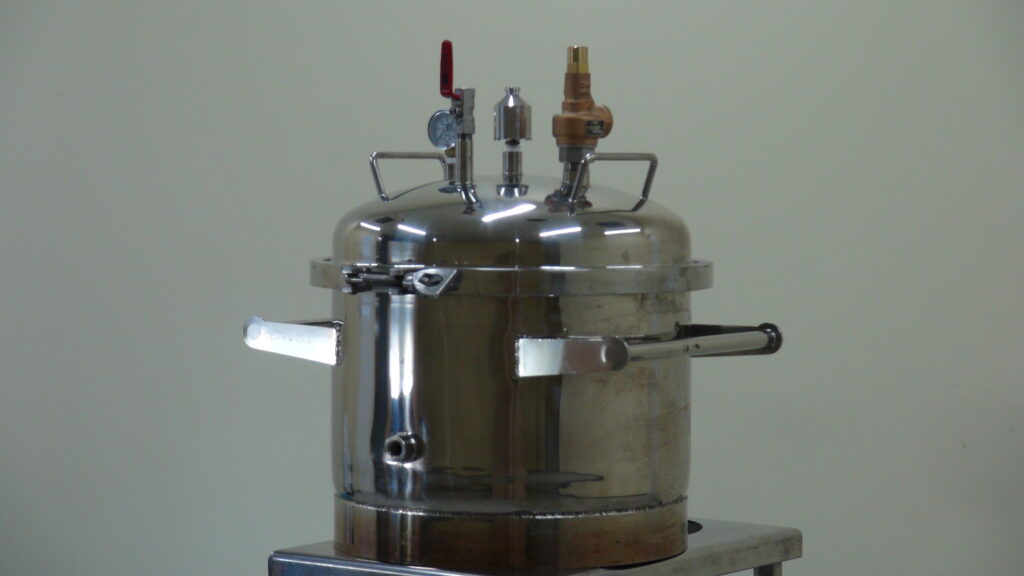
Meiwa Seisakusho’s pressure stockpot lightens both the time and the physical burden of prep by cooking sealed at about 120°C.
The simmer takes about 2–2.5 hours, easier to fit into a normal shift
A simmer that takes about 8–12 hours in a regular stockpot finishes in about 2–2.5 hours in a pressure stockpot (Meiwa Seisakusho’s in-house results). Prep becomes easier to finish within a normal shift before opening, reducing late-night and early-morning shifts just for broth.
No more standing by to stir and skim
Inside the pressure stockpot is a double structure with a perforated inner pot (basket), so bones and meat never touch the heated bottom directly. Once the specified pressure is reached, you simply hold the set time on low heat, so there is no need to keep stirring to prevent scorching. While pressurizing, scum tends to stick to the inner walls of the pot, so there is no need to keep skimming for hours either.
Move broth through the transfer hose without lifting heavy pots
Finished broth can be moved to another container through the bottom valve and a dedicated transfer hose. The broth emulsifies as it is drawn off, so there is no need to tip a heavy pot to strain it. With the 130L model, even 100L of broth is transferred in about 3–5 minutes.
Less steam and less washing up
A pressure stockpot cooks sealed, so it rarely gives off heavy steam during cooking. Parts such as the lid and inner pot can be removed for washing, so even one person can clean the 50L model in about 15–20 minutes. With the 130L model, three or four regular stockpots become one, reducing the number of pots to wash in the first place.
How to rebuild your prep schedule to change how people work
Beyond simply installing a pressure stockpot, rebuilding the prep schedule itself makes the change in how people work clear.
Cook within the normal shift before opening
Once the simmer takes about 2–2.5 hours, you can plan to finish prep within the few hours before opening. While it cooks, staff can be put on other opening preparations.
With a large model, batch-cook to reduce the number of cooking days
Meiwa Seisakusho’s 110L model makes up to 80L (about 200–260 bowls) per batch. Cooking once every three days and rapidly chilling and storing the broth means you no longer need to make broth every day, reducing the days you need someone assigned to prep.
Set the procedure in numbers so anyone can take charge
Prep with a pressure stockpot takes five steps — “add ingredients → close the lid and heat → hold pressure on low heat → depressurize and cool → draw off through the transfer hose” — and the amounts of bones and water and the pressurizing time can be set as numbers. Written into a manual, prep can be handed over without depending on particular people. The idea of managing prep by numbers is covered in detail in turning artisan intuition into numbers with “kitchen DX”.
Changing how people work also helps the business
Changing how you prep benefits not only staff but also the business.
- Labor costs: early starts and overtime just for broth go down, and the need for dedicated prep staff shrinks.
- Gas: the pot can be held on low heat once the specified pressure is reached. At one shop that introduced Meiwa Seisakusho’s 90L model, the gas bill for tonkotsu broth fell from ¥150,000 to ¥70,000 a month.
- Hiring and retention: a workplace with little late-night or early-morning prep and little heavy work is something you can describe concretely when recruiting.
Ways to ease labor shortages are also covered in why a pressure stockpot eases ramen shop labor shortages.
Frequently asked questions
How much shorter does prep become with a pressure stockpot?
Can late-night and early-morning prep be eliminated?
Does someone need to stay with it while it cooks?
Is the work of lifting heavy stockpots eliminated?
Can I check whether it works for my kitchen and broth?
Summary: protect the flavor of the broth, change the way you prep
Ramen shops have long valued taking time and trouble. But what deserves protecting is the flavor of the broth, not a long, hard way of prepping in itself.
Use a pressure stockpot to cut the time and physical burden of prep, so that broth can be made within a set shift and by the same procedure whoever is in charge. That is a realistic step toward a kitchen that attracts people and where they can keep working.
If you want to see whether you can get the same flavor as your current broth, or whether it fits your kitchen, please contact us.
▼ Inquiries about trials and quotes
For customers outside Japan, Kitchen Techno, Meiwa Seisakusho’s sales agent, is your point of contact (English support available).
• Phone: Kitchen Techno +81-3-5285-3301 (10:00–17:00 Japan time, UTC+9)
https://pressurecooker.pro/en/contact-en/