Table of Contents (click to open)
- ■ “Wait, ¥280,000…?” To the owner whose stomach dropped at the gas bill
- ■ Conclusion: the shortcut to a lower gas bill is changing how you cook the broth
- ■ The cost of the “normal” 10-plus hours on a high flame
- ■ Raise the temperature, shorten the time
- ■ Saving ¥80,000 a month is the same as ¥960,000 a year in profit
- Frequently asked questions
- ■ First, talk to us with your gas bills in hand
■ “Wait, ¥280,000…?” To the owner whose stomach dropped at the gas bill
At the end of the month, the envelope from the gas company sits on your desk. You take out the bill, see the printed amount, and freeze for a moment…
Sound familiar?
“Sales are almost the same as last month, but the gas bill alone just ate a part-timer’s wages.”
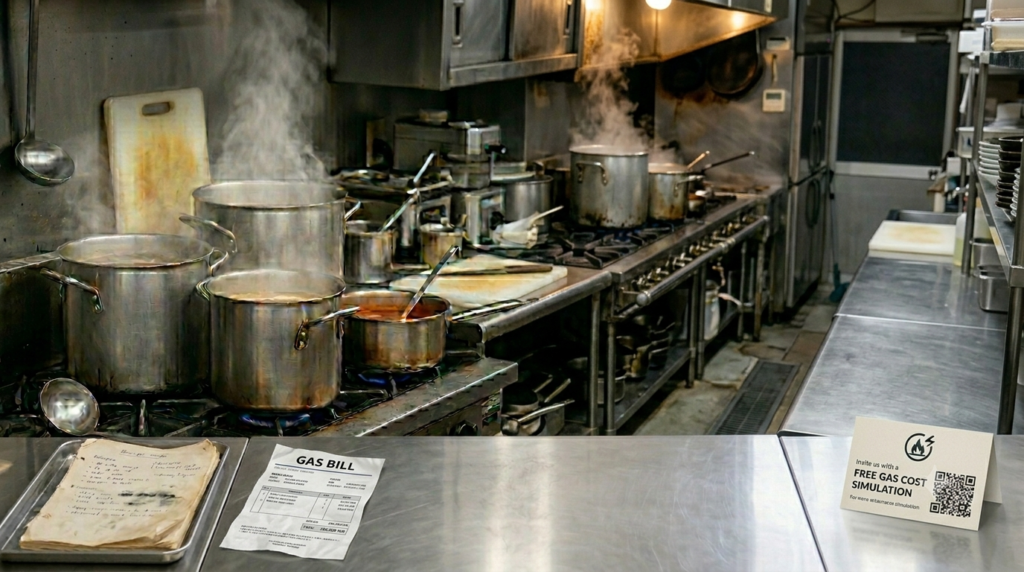
Rising energy prices quietly eat into a ramen shop’s profit. However creative you get with toppings or however carefully you turn off burners, it can feel like a drop in the bucket against the huge gas cost of prep.
■ Conclusion: the shortcut to a lower gas bill is changing how you cook the broth
The shortcut to cutting a ramen shop’s gas bill is changing how you cook the broth. Meiwa Seisakusho’s pressure stockpot can be held on low heat once pressure is reached, and the simmering time itself gets shorter. One shop that introduced the 90L model cut its gas bill for tonkotsu broth from ¥150,000 to ¥70,000 a month—almost half.
■ The cost of the “normal” 10-plus hours on a high flame
The reason ramen shops have such high gas bills is clear. To draw out the body and flavor of the signature rich broth, they keep a huge stockpot on a high flame for 10 hours or more every day.
For shops on propane (LPG), or when cold winter water takes longer to boil, one stockpot uses a great deal of gas. Some shops find they are, in effect, “paying the gas company just to cook broth.”
“But if I cut the simmering time, my flavor won’t come out.” Any cook would think that. But is spending time really the only way?
■ Raise the temperature, shorten the time
An ordinary stockpot only reaches 100°C, no matter how high the flame. To make up for that ceiling, it is cooked for hours on a strong flame while water keeps evaporating.
A pressure stockpot is a cooking vessel that seals the lid and applies pressure to raise the boiling point to about 120°C. At about 120°C, pork knuckle bones that stay hard at 100°C soften until they break by hand. With Meiwa Seisakusho’s pressure stockpot, simmering that took about 8–12 hours in a regular stockpot is finished in about 2 to 2.5 hours (company results).
What’s more, the high flame is only needed until it boils and reaches pressure. Once pressurized, you switch to low heat and hold it, so both the burner time and the flame size go down. Because the pot is sealed, water hardly escapes, which also reduces the need to top up water to adjust the concentration.
■ Saving ¥80,000 a month is the same as ¥960,000 a year in profit
Let’s put it in real numbers. If your tonkotsu gas bill goes from ¥150,000 to ¥70,000 a month, as it did at the shop using the 90L model:
- Per month: a difference of ¥80,000
- Per year: a difference of ¥960,000
How many extra bowls would you need to sell to add ¥960,000 of profit? At ¥1,000 a bowl with a 10% profit margin, it comes to 9,600 bowls a year—about 26 more bowls every day than you sell now.
Growing sales is hard. A lower gas bill, by contrast, shows up on the monthly invoice as soon as you change how you cook. It is worth comparing which will ease your stomach more.
Frequently asked questions
Why does a pressure stockpot lower the gas bill?
Are there real examples of how much it fell?
Won’t low heat make the broth weaker?
Will my own recipe taste the same?
How can I find out how much my gas bill would fall?
■ First, talk to us with your gas bills in hand
“Will my broth recipe really taste the same?”
“How many months would it take to pay back the equipment?”
If that is what you are thinking, have the gas bills for your last three months ready and get in touch. We will estimate how much your monthly cost would change with a pressure stockpot, based on your current gas charges. Any worry about flavor can be settled by cooking your own recipe at the test kitchen.
Keep paying the gas company every month, or keep that cash and put it toward your next investment. The choice is yours.
▼ Savings estimates, test cooking and overseas inquiries
For customers outside Japan, Kitchen Techno, Meiwa Seisakusho’s sales agent, is your point of contact (English support available). Test cooking with your own recipe is available at the test kitchens in Tokyo and Osaka (reservation required).
• Phone: Kitchen Techno +81-3-5285-3301 (10:00–17:00 Japan time, UTC+9)
https://pressurecooker.pro/en/contact-en/