Table of Contents (click to open)
- Conclusion: consolidate three or four stockpots into one large pressure stockpot and free up the kitchen
- The hidden “space loss” in a kitchen lined with stockpots
- What changes when you consolidate into one large pressure stockpot
- Cut wasted equipment and running costs
- What to check before installation
- Frequently asked questions
- Summary: using space efficiently leads straight to profit
Conclusion: consolidate three or four stockpots into one large pressure stockpot and free up the kitchen
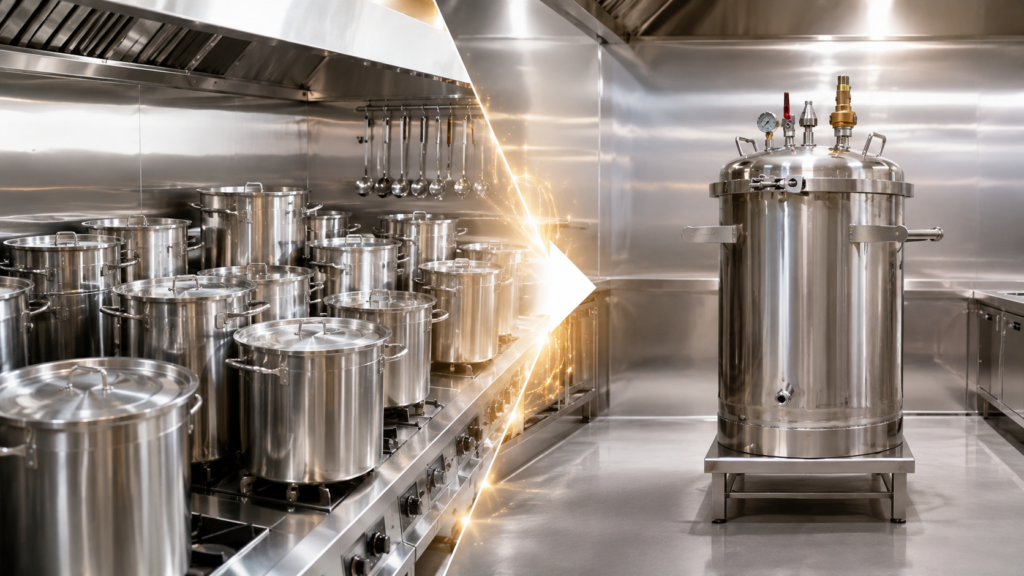
The quickest way to reduce both kitchen space and equipment costs is to reduce the number of stockpots used for prep. Meiwa Seisakusho’s 130L model can take over the prep of three or four regular stockpots in a single unit, freeing up the burners, exhaust hoods and floor space they occupied.
Restaurants and central kitchens constantly wrestle with how to use kitchen space and how to cut equipment and running costs. Stockpots used for broth, stock and sauces in particular multiply as volume grows, taking over both burners and floor. Have you resigned yourself to “more sales means more stockpots”?
The hidden “space loss” in a kitchen lined with stockpots
In many ramen shops and central kitchens, three or four stockpots sit on the range while staff rush around keeping an eye on the flames. This “kitchen lined with stockpots” hides several losses that are hard to see.
Disrupted work flow and not enough space
When stockpots occupy the range, there are not enough burners for other menu items or side dishes. Spare stockpots and bone containers end up on the floor, narrowing the paths staff need to move safely.
More stockpots also means more large pots taking up room at the sink. Steam and heat increase too, daily cleaning takes longer, and the working environment gets harder.
What changes when you consolidate into one large pressure stockpot
Meiwa Seisakusho’s 110L and 130L models are large units designed for big chains and central kitchens. Prep that used to take several stockpots can be brought together in one.
Burners are freed up
The 130L model can cook the prep of three or four regular stockpots in one unit. Burners that were tied up with prep become free, making it easier to use them at peak times or to cook new menu items at the same time.
Cook in bulk and cook on fewer days
The 110L model makes up to 80L (about 200–260 bowls) per batch, so you can cook once every three days and rapidly chill and store the broth. Large volumes of finished broth can be moved to another pot or a storage tank through the transfer hose; with the 130L model, even 100L of broth is transferred in about 3–5 minutes.
Less steam and heat hanging in the kitchen
A pressure stockpot cooks with the lid closed and sealed, so it rarely gives off heavy steam during cooking. With no more steam rising from several pots at once, the kitchen becomes easier to see across, and even an open kitchen or one visible from the dining room looks neat and clean.
Cut wasted equipment and running costs
Running several stockpots means needing a burner for each and a large exhaust hood. Consolidating into one unit cuts both these equipment costs and the daily running costs.
Initial costs: smaller burners, hoods and space
Lining up several stockpots requires a high-output soup range for each pot, a large exhaust hood and a wide kitchen (and the rent that goes with it). Consolidating into one 130L model greatly reduces these surrounding equipment costs, shrinking the initial investment for a new shop or a kitchen renovation.
Running costs: less gas and less washing
- Gas: a pressure stockpot uses high heat only until it boils and reaches pressure, then holds on low heat. Compared with keeping several stockpots on a high flame for hours, it uses gas more sparingly. One shop that introduced the 90L model cut its gas bill for tonkotsu broth from ¥150,000 to ¥70,000 a month.
- Washing up: with the stockpots consolidated into one, there is less washing every day. The inner pot keeps solids off the bottom, so it scorches less and needs less scrubbing.
What to check before installation
Before installing a large pressure stockpot, it helps to check three things: the floor, licensing and inspections.
- Floor: on a typical kitchen floor, it can basically be installed without reinforcement. The 110L model weighs around 150 kg in total with water and ingredients.
- Licensing: under Japanese regulations, the 130L model is designed to fall within the category of a “small pressure vessel,” so in Japan no licensed boiler operator is required.
- Inspections: statutory inspections in Japan are once a year regardless of capacity. Outside Japan, the rules of the destination country apply.
How to check the delivery route width and the space above for removing the lid is explained in detail in the pre-installation checklist for commercial pressure cookers.
Frequently asked questions
How many stockpots can one pressure stockpot replace?
What costs go down when you consolidate into one unit?
Does a large pressure stockpot need floor reinforcement?
Are licenses or inspections required for a large unit?
Can I try the large models?
Summary: using space efficiently leads straight to profit
Using kitchen space efficiently does more than make work easier. Cutting unnecessary investment in burners and hoods, holding down daily gas and prep time, and creating new sales in the space you free up all add up to running a more efficient business.
“Our kitchen is too small to increase output or add shops.” “We need to cut our monthly gas bill and prep work somehow.” If that sounds familiar, consider consolidating into one high-capacity unit instead of adding more stockpots and crowding the kitchen.
▼ Trying large models, kitchen layout and overseas inquiries
For customers outside Japan, Kitchen Techno, Meiwa Seisakusho’s sales agent, is your point of contact (English support available).
• Phone: Kitchen Techno +81-3-5285-3301 (10:00–17:00 Japan time, UTC+9)
https://pressurecooker.pro/en/contact-en/