Table of Contents (click to open)
- Conclusion: safety devices and a fixed procedure reduce both “scary” and “difficult”
- 1. Clearing up “high pressure = danger”: pressure control and safety devices
- 2. Why anyone can make the same broth without a cook’s instinct
- 3. Free your staff from standing over the pot
- 4. The effect in numbers
- 5. Before you buy: test with your recipe and plan for export
- Frequently asked questions
- Summary: safety devices and a fixed procedure build a kitchen that doesn’t depend on one person
“Isn’t a high-pressure pot dangerous?” This article answers that worry with the safety devices of a pressure stockpot and a prep procedure that lets inexperienced staff make the same broth.
Conclusion: safety devices and a fixed procedure reduce both “scary” and “difficult”
Meiwa Seisakusho’s commercial pressure stockpot manages pressure with dual safety valves, a pressure gauge and a pressure-release mechanism, and prep follows five fixed steps. That means both worries—“high pressure is scary” and “we can’t make broth without a skilled cook”—can be reduced by design.
Still, it is only natural for an owner responsible for a shop and its staff to be cautious about high-pressure equipment. “Could one mistake cause a serious accident?” “Is it safe to let part-timers and new hires touch it?” This article answers those concerns one by one.
1. Clearing up “high pressure = danger”: pressure control and safety devices
Meiwa Seisakusho’s pressure stockpot is designed to run at a working pressure of 0.13–0.3 MPa depending on the model. The larger the model, the lower the working pressure: 0.3 MPa for the 50L and 0.13 MPa for the 130L.
① Safety valve: releases steam automatically if pressure rises too high
A safety valve is a part that automatically releases steam to prevent bursting when the internal pressure rises above the set limit. Meiwa Seisakusho’s pressure stockpot has two of these safety valves. Even if the flame is too strong, the pressure will not keep rising without limit.
② Residual-pressure valve and pressure gauge: release the pressure before opening the lid
Opening the lid while pressure remains could cause hot broth to spray out. So after heating, the pressure is lowered by natural depressurization or water cooling, and the remaining pressure is released with the residual-pressure valve before the lid is opened. The pressure gauge on the front shows at a glance that the pressure has dropped, so there is no guessing about when it is safe to open.
③ Sealed structure: less boil-over and splashing
With an open stockpot, splashing boiling broth is a daily burn risk. A pressure stockpot cooks with the lid closed and sealed, so broth hardly splashes out, and there is rarely heavy steam or loud noise. Turning the gas down to low once the set pressure is reached also keeps the pressure-release sound down. Beyond the safety devices, the daily work itself becomes safer.
Under Japanese regulations, the 130L model is designed to fall within the category of a “small pressure vessel,” so in Japan no licensed boiler operator is required.
2. Why anyone can make the same broth without a cook’s instinct
A pressure stockpot is a system in which broth comes out close to the same every time if you cook to the conditions you set, without relying on a cook’s fine control of the flame. Here are two reasons why “broth needs a craftsman’s instinct” no longer has to be true.
Sealed cooking keeps weather and humidity from changing the reduction
In a regular stockpot, the amount of evaporation changes with the day’s temperature, humidity and ventilation, so broth turns out thin or over-reduced. A pressure stockpot cooks sealed, so water hardly escapes and the outside environment has little effect. Fix the amounts of bones and water and the pressurization time, and you cook under nearly the same conditions every time.
At about 120°C, bones soften until they break by hand
Raising the boiling point to about 120°C with pressure softens pork knuckle bones, which stay hard in a regular stockpot, until they break by hand. Because flavor is drawn from the core of the bone, a cook no longer needs to judge the bones and adjust the cooking time. Broth concentration can reach up to Brix 12% or more (two-stage pressurization).
3. Free your staff from standing over the pot
A pressure stockpot removes the heaviest parts of open-pot prep—stirring and straining or transferring—and reduces the time staff spend tied to the pot.
No stirring needed
With an open stockpot, staff had to stir again and again with a big paddle to keep bones and vegetables from scorching on the bottom, which is hard on backs and shoulders. Meiwa Seisakusho’s pressure stockpot has a double structure in which the inner pot keeps solids off the bottom of the vessel, preventing scorching. Once pressure is reached, you only switch to low heat and hold it for the set time, so staff can move on to other prep in the meantime.
Transfer and emulsify at once with the transfer hose
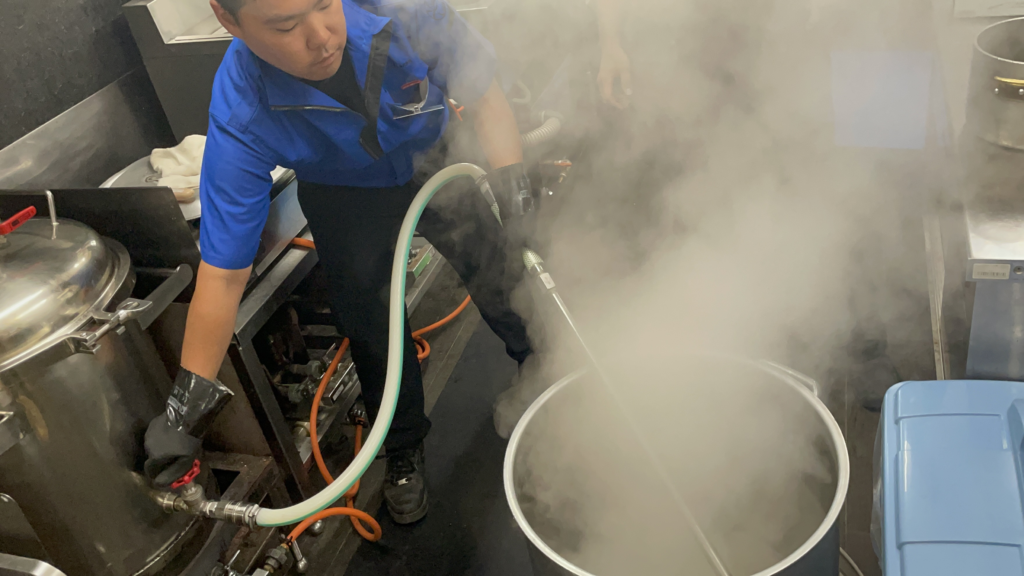
Finished broth is moved to another container through the dedicated transfer hose and valve. Nobody has to lift and tip a heavy pot, and the broth emulsifies automatically as it is drawn off, giving a smooth paitan without straining or stirring.
4. The effect in numbers
Here is how time, gas costs and labor change with Meiwa Seisakusho’s pressure stockpot, based on published specifications and results at shops that use it.
| Item | Regular stockpot | Meiwa Seisakusho pressure stockpot |
|---|---|---|
| Prep time | Tonkotsu can take 10 hours or more | Half the conventional time or less (one 90L user cut it to about a quarter) |
| Gas cost | Long heating pushes it up | A 90L user went from about ¥150,000 to about ¥70,000 a month (about ¥960,000 a year) |
| Broth concentration (Brix) | Varies with reduction (around 6–8%) | Up to 12% or more (two-stage pressurization) |
| Prep procedure | Constant stirring and straining; heat judged by a cook’s instinct | Five steps; no stirring or straining |
Gas costs fall because you use high heat only until it boils and reaches pressure, then hold it on low heat once pressurized, and because the cooking time itself is shorter. Prep follows five steps—① load the ingredients → ② close the lid and heat → ③ hold the pressure on low heat → ④ depressurize and cool → ⑤ draw off the broth through the transfer hose—and time and heat can be set as numbers.
The owner of Menya Nojo, a chicken paitan specialty shop in Japan, admits he once doubted that easy work could make good broth. Now he says that because time, numbers and the strength of the gas can all be fixed instead of left to feel, the pressure stockpot makes it easier to teach staff consistently (customer interview video, in Japanese).
5. Before you buy: test with your recipe and plan for export
Meiwa Seisakusho’s pressure stockpot can be tested with your own recipe before purchase. If you are still unsure whether your bone-to-water ratio will work, trying it on the actual unit is the fastest way to find out.
① Test kitchens in Tokyo and Osaka
At the test kitchens in Tokyo and Osaka, you can try making broth with your own recipe free of charge (reservation required). If you are planning a visit to Japan, ask Kitchen Techno about scheduling.
② Specifications and documents for export
For export, the unit must meet the pressure-vessel regulations of the destination country. Meiwa Seisakusho can manufacture to ASME BPVC Section VIII, Division 1, and also accepts OEM and custom-size orders. Tell Kitchen Techno your destination and requirements first.
Frequently asked questions
Are commercial pressure stockpots dangerous?
What should I watch out for when opening the lid?
Can staff with no experience use it?
Is it noisy or steamy while cooking?
Can it be exported and built to ASME?
Summary: safety devices and a fixed procedure build a kitchen that doesn’t depend on one person
Meiwa Seisakusho’s pressure stockpot manages pressure with dual safety valves, a pressure gauge and a pressure-release mechanism, and the lid is opened only after the pressure is released. Because it cooks sealed, it is little affected by the outside environment, and with five steps and conditions set as numbers, anyone can come close to the same broth. The heavy work of stirring and transferring disappears, and gas costs go down. As a first step away from “the shop can’t run without a veteran cook,” try it with your own recipe.
▼ Overseas purchases, export and ASME inquiries
For customers outside Japan, Kitchen Techno, Meiwa Seisakusho’s sales agent, is your point of contact (English support available).
• Phone: Kitchen Techno +81-3-5285-3301 (10:00–17:00 Japan time, UTC+9)
https://pressurecooker.pro/en/contact-en/