Table of Contents (click to open)
- Conclusion: the difference between chintan and paitan is convection and emulsification, and a pressure stockpot separates them by how the broth is drawn off
- What is the difference between chintan and paitan?
- Key points for making chintan in a pressure stockpot
- Key points for finishing paitan in a pressure stockpot
- How to think about running chintan and paitan in one unit
- Frequently asked questions
- Summary: understand the difference, and one unit can make both
Conclusion: the difference between chintan and paitan is convection and emulsification, and a pressure stockpot separates them by how the broth is drawn off
What decides the difference between chintan and paitan is whether the fat in the broth mixes with the water, in other words emulsification. Meiwa Seisakusho’s pressure stockpot can draw off broth either as a clear chintan or as an emulsified paitan by adjusting how the valve is opened and how pressure is released, so one unit can handle both broths.
Ramen broth falls broadly into “chintan,” clear broth that keeps the umami of the ingredients without clouding, and “paitan,” creamy broth with bone marrow and fat dissolved into it. In a regular stockpot, the heat and the time needed are completely different, so making both used to require separate pots and someone constantly watching the flame.
What is the difference between chintan and paitan?
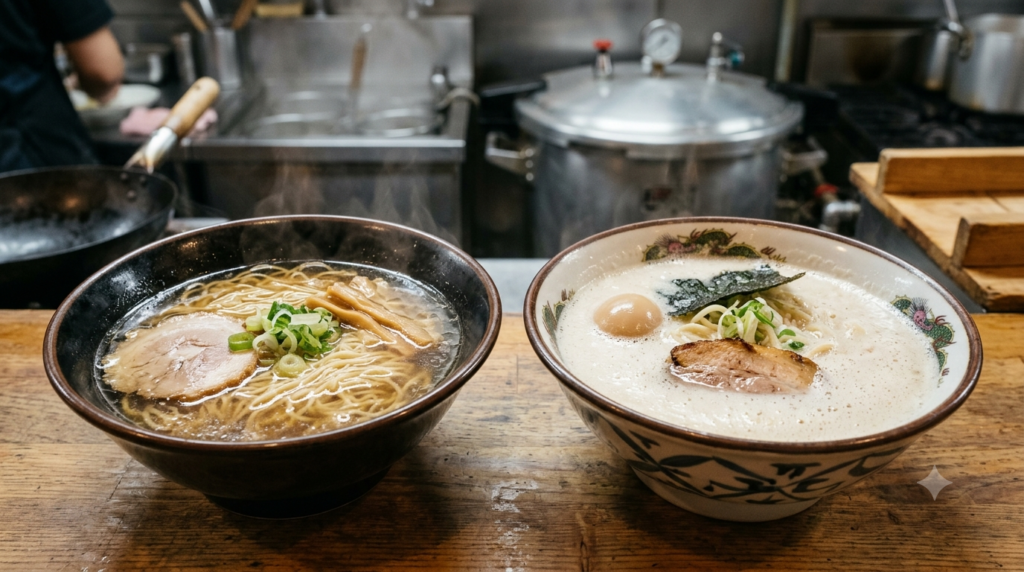
Whether broth stays clear or turns cloudy white depends on the fat and collagen (gelatin) dissolved into it, and on convection in the pot (how hard it boils).
| Item | Chintan (clear broth) | Paitan (white, rich broth) |
|---|---|---|
| Appearance | Clear, with the fat floating separately on top | Cloudy white, with fat and water mixed together |
| Key factor | Keep convection down and finish quietly | Break the fat into fine droplets and mix it with collagen (gelatin) |
| How to draw off with a pressure stockpot | After turning off the heat, lower the pressure gently rather than releasing it suddenly, then draw off | Emulsify as the broth is drawn off through the transfer hose |
Chintan: keep the fat unmixed and floating separately on top
Chintan is a broth simmered slowly on low heat without boiling, so that the umami dissolves while the fat floats to the surface without mixing with the water. As long as the pot stays calm, the fat gathers on the surface in large droplets and the broth stays clear.
Paitan: emulsification, where fat and collagen mix together
Paitan is a cloudy white broth made by boiling hard to break the fat into fine droplets and mixing it with the water through the action of collagen (gelatin) dissolved from the bones. This phenomenon, in which water and fat that normally do not mix blend evenly, is called emulsification.
Key points for making chintan in a pressure stockpot
What matters most when making chintan in a pressure stockpot is keeping the broth calm both while it cooks and after it finishes.
Sealed cooking keeps aroma in and scum out of the broth
A pressure stockpot cooks sealed with the lid closed, so aroma does not keep escaping with heavy steam as it does from a regular stockpot. While pressurizing, scum tends to stick to the inner walls of the pot and is less likely to mix into the broth. There is no need to keep skimming for hours.
After cooking, lower the pressure gently rather than releasing it suddenly
The step that needs the most care with chintan is depressurizing after cooking. With a Meiwa Seisakusho pressure stockpot, once heating is finished the pressure is lowered by natural depressurization or water cooling. Lowering the pressure suddenly makes the broth bubble up and stir, mixing the surface fat into the broth and clouding it, so for chintan the pressure is lowered gently before drawing off.
Key points for finishing paitan in a pressure stockpot
When finishing paitan in a pressure stockpot, the key is to dissolve plenty of collagen under pressure and to emulsify the broth as it is drawn off.
Pressurizing at about 120°C dissolves the collagen from the bones
A pressure stockpot cooks broth under pressure at about 120°C. Pressurizing until the bones are soft enough to snap by hand dissolves plenty of bone marrow and collagen into the broth, providing what emulsification needs. A simmer that takes about 8–12 hours in a regular stockpot also finishes in about 2–2.5 hours (Meiwa Seisakusho’s in-house results).
The broth emulsifies automatically as it is drawn off through the transfer hose
Finished broth emulsifies automatically as it is drawn off through the transfer hose. Without tipping a heavy pot to strain it or stirring with a wooden paddle, it becomes a paitan with fat and water mixed together. The double structure keeps solids off the bottom with an inner pot, so even thick broth does not scorch.
How to think about running chintan and paitan in one unit
Every Meiwa Seisakusho pressure stockpot model is used with the same five steps (add ingredients → close the lid and heat → hold pressure on low heat → depressurize and cool → draw off through the transfer hose). What changes between chintan and paitan is the ingredients, the pressurizing time, and how the pressure is lowered and the broth drawn off.
The working pressure is fixed for each model (50L: 0.3 MPa, 90L: 0.2 MPa, 110L: 0.15 MPa, 130L: 0.13 MPa). How long to pressurize depends on the type and amount of bones and the strength you are aiming for, so the surest way is to decide by testing with real ingredients.
For safety, the lid cannot be opened while pressurized. Follow the procedures in the instruction manual for depressurizing and drawing off. Meiwa Seisakusho’s pressure stockpots come standard with double safety valves, a pressure gauge and a pressure-release mechanism.
Frequently asked questions
Can one pressure stockpot make both chintan and paitan?
What is the key to keeping chintan from turning cloudy?
How is paitan emulsified?
Do I need to skim off scum?
Can I try both chintan and paitan with my own broth?
Summary: understand the difference, and one unit can make both
Separating chintan from paitan is not decided only by a cook’s determination or by long simmering. It can be explained by convection in the pot and by whether fat and water mix (emulsification).
A pressure stockpot is a cooking tool that cooks sealed at about 120°C and changes the result through how the pressure is lowered and the broth drawn off. Even a shop that wants both light and rich broths on its menu can consolidate prep without lining up several stockpots.
If you want to see whether your chintan can be made clear in a pressure stockpot, or whether your paitan can be made creamier, please contact us.
▼ Inquiries about trials and quotes
For customers outside Japan, Kitchen Techno, Meiwa Seisakusho’s sales agent, is your point of contact (English support available).
• Phone: Kitchen Techno +81-3-5285-3301 (10:00–17:00 Japan time, UTC+9)
https://pressurecooker.pro/en/contact-en/