Table of Contents (click to open)
- In short: cooking chashu in a pressure cooker takes the pot above 100°C, so the pork turns tender in much less time
- 1. Is ramen chashu grilled or braised?
- 2. Why does pressure cooking make meat tender?
- 3. What to watch when cooking chashu in a home pressure cooker
- 4. Why is it hard to match a ramen shop’s chashu with a home pressure cooker?
- 5. How do you prepare chashu in large batches in a shop?
- 6. How do you cool and store chashu after cooking?
- FAQ
- Summary: follow the manual at home; settle the conditions by test cooking in a shop
In short: cooking chashu in a pressure cooker takes the pot above 100°C, so the pork turns tender in much less time
When you cook chashu in a pressure cooker, the inside of the pot rises above 100°C, so the pork becomes tender in less time than in an ordinary pot.
- At home: Follow your pressure cooker’s instruction manual for the amount of food, the amount of liquid and the pressurizing time. Open the lid only after you have confirmed that the pressure inside has dropped
- In a shop making large batches: The 130L product page of Meiwa Seisakusho presents the model as also ideal for large amounts of chashu (braised pork)
- Doneness: Cook the pork until the center is fully done, and check it with a probe thermometer according to the food-safety rules where you live
- Cooling: Cool cooked pork quickly, and follow the cooling and storage rules of your local food-safety authority
You want chashu so tender it can be cut with chopsticks, like the kind in a ramen shop, and you want to make it at home. Simmering a pot for hours is a lot of work, so you think of trying a pressure cooker. But you do not know how many minutes to pressurize it, or what makes a ramen shop’s chashu different.
A pressure cooker is a tool that shortens the time it takes to braise chashu. But what you need to watch differs between cooking at home and a ramen shop that prepares large batches every day. Meiwa Seisakusho, which makes commercial pressure cookers (pressure stockpots), explains how pressure softens meat and what to watch when cooking at home and in a shop.
1. Is ramen chashu grilled or braised?
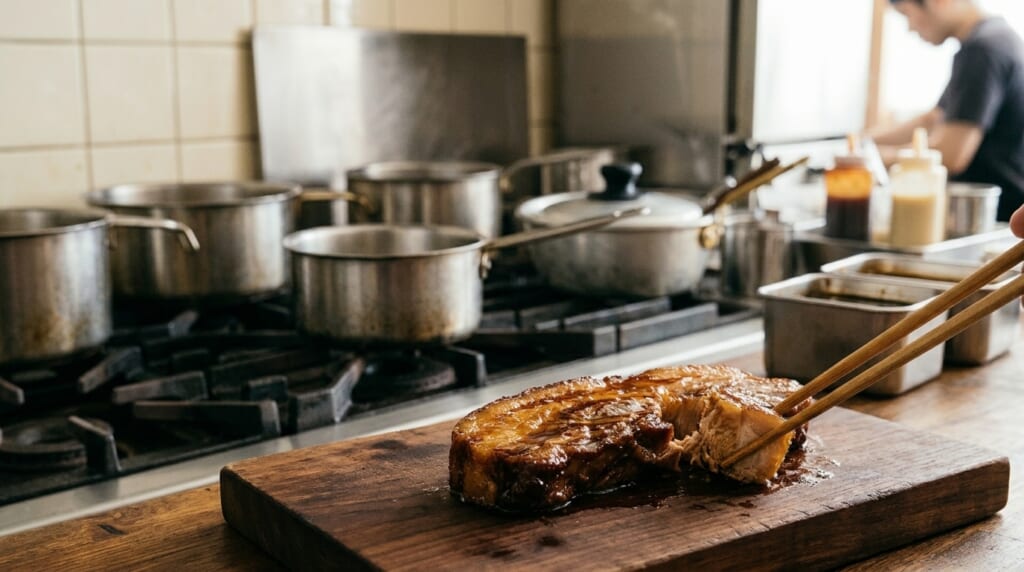
Chashu (叉焼) was originally a Chinese dish of seasoned pork that is roasted. In Japanese ramen, pork braised in soy sauce and other seasonings is also commonly called chashu, and shops differ on whether they roast or braise it.
A pressure cooker helps with braised chashu. It shortens the step of simmering a block of pork belly or pork shoulder loin in the braising liquid until tender.
2. Why does pressure cooking make meat tender?
Meat cooked in a pressure cooker becomes tender because the temperature inside the pot is higher than in an ordinary pot. In an ordinary pot, water boils at 100°C and the temperature goes no higher. A pressure cooker is sealed with its lid, and by raising the pressure inside it raises the temperature at which water boils (the boiling point) above 100°C.
The collagen that is plentiful in the sinew and skin of meat turns into gelatin as heating continues, and the meat softens. This change generally proceeds faster at higher temperatures. That is why a step that takes hours in an ordinary pot can be finished in a much shorter time under pressure. In Meiwa Seisakusho’s commercial pressure cooker (pressure stockpot), the temperature rises to about 120°C (248°F) under pressure, and the pork knuckle bones used for broth become soft enough to snap by hand.
How pressure raises the temperature is explained in “Why Cook at 120°C? The Science of How Pressure Cooking Draws Out Umami and Body More Easily.”
3. What to watch when cooking chashu in a home pressure cooker
When you cook chashu in a home pressure cooker, following the usage rules set for your particular cooker is the basis of cooking it safely and well. That is because the amount of food you may put in, the amount of liquid required and the guide for pressurizing time differ from model to model.
- Amount: Do not go above the maximum fill line in the instruction manual
- Liquid: Add at least the minimum amount of liquid the instruction manual specifies
- Check before use: Make sure the steam vent and other pressure-regulating parts are not clogged, and that the gasket between the lid and the body is not slimy or worn
- Pressurizing time: It changes with the cut, size and amount of meat. Start from the guide for meat dishes in the instruction manual, and settle on your own time by checking the texture
- Opening the lid: Open it only after you have confirmed that the pressure inside the pot has dropped
- Doneness: Check that the pork is cooked through to the center, using a probe thermometer and the food-safety rules where you live
Some people leave the chashu to cool in its braising liquid. But if the pork stays lukewarm for a long time, it spends longer in the temperature range where bacteria multiply easily, so also read section 6 on cooling.
4. Why is it hard to match a ramen shop’s chashu with a home pressure cooker?
It is hard to match a ramen shop’s chashu with a home pressure cooker because the amount of meat, the braising liquid and the batch size differ greatly between a shop and a home. Even if you cook the same cut for the same time, the result changes when the conditions in the pot are different.
- Amount of meat: A shop braises several blocks of pork at once in a large pot. The ratio of meat to braising liquid differs from that at home
- Braising liquid: Some shops use the liquid in which the chashu was braised for the ramen tare (seasoning base) and other uses. Liquid used every day has the flavor of the meat layered into it
- Batch size and time: A shop braises a fixed amount in a fixed time every day. At home, both amount and time tend to change each time
To get closer to a shop’s result at home, record the amount of meat, the amount of liquid and the pressurizing time each time, and change one thing at a time to compare. That makes it easier to find the conditions that suit your own cooker.
5. How do you prepare chashu in large batches in a shop?
A ramen shop that prepares chashu in large quantities every day can use a commercial pressure cooker (pressure stockpot). The FAQ on Meiwa Seisakusho’s 130L product page presents the 130L model as ideal for large amounts of chicken paitan and beef bones, large amounts of chashu (braised pork), fond de veau and similar. The 50L, 90L and 110L product pages do not mention chashu, so the sure way to find out whether they can be used for braised pork is a test cook.
- Amount: The 130L has a water capacity of 120 L and can draw off 66–100 L (guide) of broth per batch. Settle the ratio of meat to braising liquid by test cooking
- Scorching: According to the 90L product page, a double structure with a perforated inner pot (basket) keeps solids such as bones and meat from touching the bottom of the pot, where the flame heats it directly. The inner pot of the 130L is reinforced with extra-thick stainless steel to bear the weight of large amounts of bones and meat
- Moving the liquid: Broth can be moved to another container, without lifting the pot, through the bottom valve and a dedicated liquid transfer hose. On the 130L, even 100 L takes about 3 to 5 minutes. Whether the braising liquid of braised pork can be moved the same way should be checked at the test cook
- While under pressure: According to the 90L product page, the lid cannot be opened partway through pressurized cooking, for safety. If you want to taste or check the meat, settle the pressurizing time at the test-cooking stage
A shop that prepares both broth and chashu in the same pressure stockpot can reduce the time the pot sits empty by building the order and timing of the work into the day’s schedule. The steps for releasing the pressure before opening the lid are explained in “Are Commercial Pressure Stockpots Safe? Safety Valves, Residual-Pressure Valves, and Broth Automation Anyone Can Run.”
Source: Meiwa Seisakusho product pages (50L, 90L, 110L, 130L): FAQ and specifications (checked November 6, 2026)
6. How do you cool and store chashu after cooking?
Cooked chashu should be cooled so that it spends as little time as possible in the temperature range where bacteria multiply easily. Food-safety rules for cooling cooked food differ by country and region, so check those of the authority where your shop is. The general points are as follows.
- Bacteria multiply fastest in the warm range between cold storage and hot holding, so shorten the time the pork spends there
- Use a chiller, or divide the pork into portions in clean, sanitary containers, to cool it quickly
- Record the time cooling started and the time it finished
- Keep food that is not served immediately either cold or hot, within the limits set by your local rules
A large block cools slowly at the center, so cutting it into pieces or moving it into shallow containers shortens the time it takes to cool. Cooking temperatures and cooling times differ by authority (for example, the food-safety guidance published by the USDA in the United States), so confirm the figures with your local health authority.
FAQ
Why does chashu cooked in a pressure cooker turn out dry?
How can I use the liquid the chashu was cooked in?
Is a commercial pressure cooker worth buying just for chashu?
Summary: follow the manual at home; settle the conditions by test cooking in a shop
A pressure cooker shortens the braising time for chashu by raising the temperature in the pot above 100°C. At home, first cook once using the guide for meat dishes in the manual and record the pressurizing time and texture. If you prepare large batches every day in a shop, write down how many hours a day chashu and broth prep take, and you will see how much time a commercial pressure cooker can change.
Videos of broth being prepared in a commercial pressure cooker (pressure stockpot) are on Meiwa Seisakusho’s YouTube channel (in Japanese). If you plan to visit Japan, you can also bring your own pork and braising liquid to the test kitchens in Tokyo and Osaka (reservation required). For the ASME standard required in export destinations, see “ASME Pressure Vessel Code for Ramen Shops Abroad: What to Check and How to Make the Same Broth Overseas.”
▼ Inquiries about trials and quotes
For customers outside Japan, Kitchen Techno, Meiwa Seisakusho’s sales agent, is your point of contact (English support available). Purchases, export, OEM and ASME inquiries are handled there. If you plan to visit Japan, trials at the test kitchens in Tokyo and Osaka are also possible (reservation required).
• Phone: Kitchen Techno +81-3-5285-3301 (10:00–17:00 Japan time, UTC+9)
https://pressurecooker.pro/en/contact-en/