Table of Contents (click to open)
- In short: chicken paitan is a white, cloudy chicken broth made by boiling hard until the fat and water emulsify
- 1. How is chicken paitan different from chintan and tonkotsu broth?
- 2. Where do the whiteness and body of chicken paitan come from?
- 3. How do chicken paitan specialty shops cook their broth?
- 4. What changes when you cook chicken paitan in a commercial pressure cooker?
- 5. Why is it hard to recreate a shop’s chicken paitan at home?
- 6. How can you try a commercial pressure cooker with your own shop’s chicken paitan?
- FAQ
- Summary: how long chicken paitan takes comes down to cooking time and watching the flame
In short: chicken paitan is a white, cloudy chicken broth made by boiling hard until the fat and water emulsify
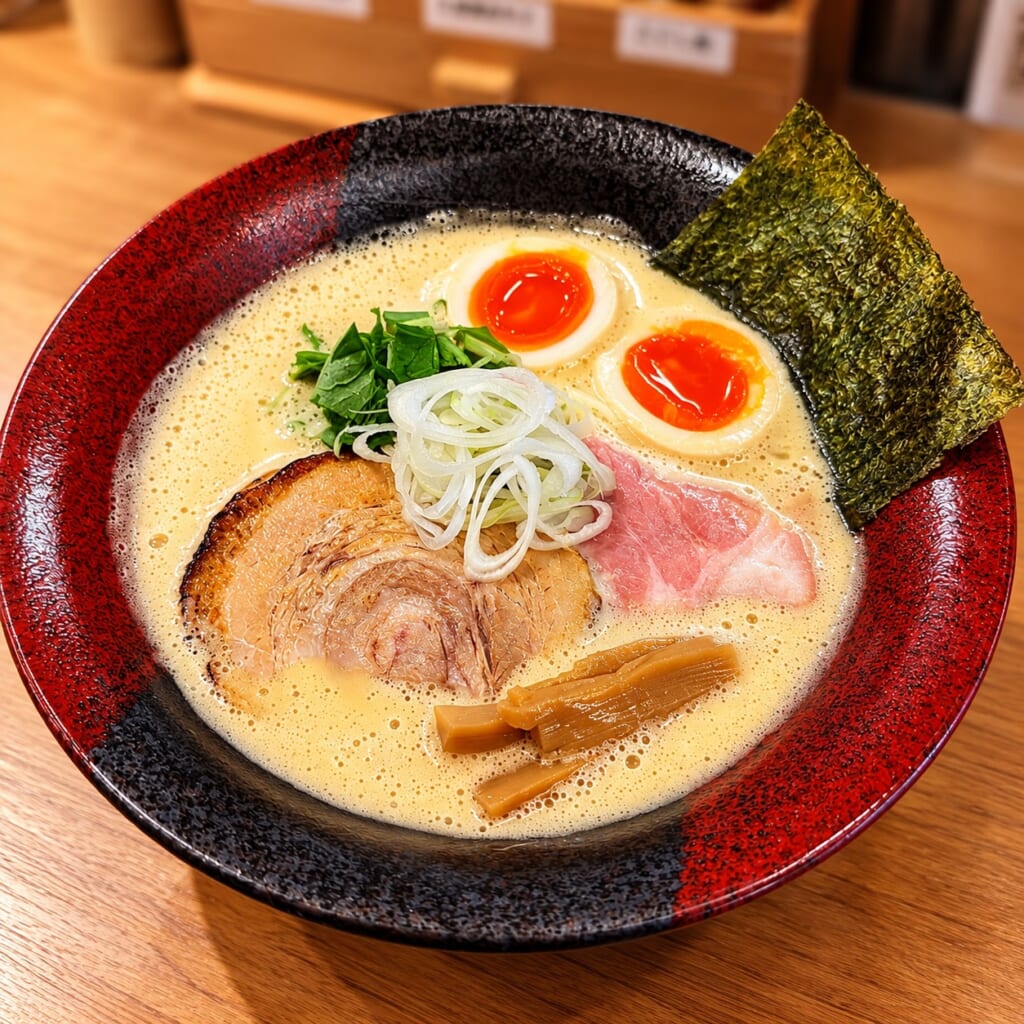
Chicken paitan (tori paitan) is a white, cloudy chicken broth made by boiling chicken carcasses (tori-gara), chicken feet (momiji), whole chickens and similar ingredients over high heat until the fat and water that come out of them emulsify. For a shop, it is also a broth that demands a lot of watching the flame and heavy physical work.
- How it differs from chintan: Even from the same chicken bones, simmering gently without boiling gives a clear chicken chintan, while boiling hard until it emulsifies gives white chicken paitan
- Why it is white and thick: Emulsification, in which the fat and water from the bones mix finely, plus collagen from ingredients such as chicken feet
- How shops cook it: In a regular stockpot, the carcasses are crushed and boiled hard for a long time. At the chicken paitan specialty shop 麺屋 野条, it used to take about 10 hours
- With a commercial pressure cooker: At 麺屋 野条, total prep time became about 3 to 4 hours shorter
White, creamy, full of chicken aroma, and yet not heavy by the last bowl. How a broth like that is cooked in a shop kitchen is not widely known. Meiwa Seisakusho, which makes commercial pressure cookers (pressure stockpots), explains what chicken paitan is and how shops cook it, based on an interview with the owner of the chicken paitan specialty shop 麺屋 野条 and on the results of our products.
1. How is chicken paitan different from chintan and tonkotsu broth?
Chicken paitan is distinguished from other broths by its chicken-bone base and by being boiled hard until it turns white and cloudy. Even with the same chicken bones, a different cooking method gives a clear chintan, and even among paitan, pork bones make tonkotsu broth.
| Broth | Main ingredients | Cooking method | Appearance |
|---|---|---|---|
| Chicken chintan (tori chintan) | Chicken carcasses, whole chickens | Simmered gently without boiling | Clear |
| Chicken paitan (tori paitan) | Chicken carcasses, chicken feet (momiji), whole chickens | Boiled hard and vigorously so the fat and water emulsify | White and cloudy, with body |
| Tonkotsu (paitan) | Pork knuckle bones (genkotsu, the joint ends of pork thigh bones), pork back bones (segara), etc. | Boiled hard and vigorously so the fat and water emulsify | White and cloudy |
*If the table is cut off, scroll sideways.
Source: Meiwa Seisakusho, “Ramen and Kitchen Glossary” (chintan, paitan, chicken chintan, chicken carcass, momiji, whole chicken, genkotsu, segara)
How to cook chintan and paitan separately is explained in “Chintan vs Paitan: How Pros Make Both with Valve and Pressure Control in a Pressure Cooker.”
2. Where do the whiteness and body of chicken paitan come from?
Chicken paitan turns white because the fat and water that come out of the bones are boiled hard and mix finely. This phenomenon, in which water and fat that normally do not mix blend evenly through heat and the action of collagen, is called emulsification.
Collagen from chicken feet (momiji) in particular is involved in the body of the broth. Momiji is rich in collagen and is used when you want to give the broth strong body and stickiness.
To make a white, rich chicken paitan in a shop, the fat and collagen must be fully extracted from the bones. That is why, in a regular stockpot, boiling hard for a long time while crushing the carcasses and stirring constantly is essential.
3. How do chicken paitan specialty shops cook their broth?
麺屋 野条 in Nishinomiya, Hyogo, is a chicken paitan specialty shop. The owner, Mr. 野条 (野条 岳), describes the broth he aims for as “rich, yet light.”
Wherever he worked, Mr. 野条 cooked chicken paitan in a regular stockpot. He says he used to cook it for about 10 hours.
The burden of a long-cooked broth was not only time. Between the lunch and dinner services (idle time), someone still had to keep watching the broth. Crushing the carcasses and stirring constantly is also hard on the body. Because the method relied heavily on feel, it was hard to teach to the next person, which Mr. 野条 named as another worry.
Interview: Mr. 野条 (野条 岳), owner of 麺屋 野条 (Nishinomiya, Hyogo; chicken paitan specialty shop), 2026
4. What changes when you cook chicken paitan in a commercial pressure cooker?
A commercial pressure cooker (pressure stockpot) is a pot that is closed with a lid, pressurized inside, and raises the boiling point of water to about 120°C (248°F) to cook broth. Because it cooks above 100°C, it can extract flavor and collagen from bones in less time than a regular stockpot.
Since 麺屋 野条 introduced Meiwa Seisakusho’s commercial pressure cooker, its chicken paitan prep has changed as follows.
- Prep time: About 3 to 4 hours shorter overall
- Heavy work: Crushing carcasses and stirring constantly were reduced by about 2 to 3 hours overall
- Idle time: No need to watch the flame, so he can rest with peace of mind
- Kitchen heat: Gas is used for less time and no steam escapes while the pot is pressurized, so heat builds up less
- Flavor: He likes the freshness of the broth
- Teaching: Because the cooking method can be set by time and numbers, staff can reproduce it after being taught
The emulsification that makes the broth white and rich happens automatically as the finished broth is drawn off through the valve at the bottom of the pot with the dedicated liquid transfer hose. Inside the pot is a perforated inner pot (basket), a double-layer structure that keeps bones and meat from touching the bottom of the pot where the flame hits. So even a thick broth is less likely to scorch on the bottom.
Mr. 野条 also speaks frankly about what took getting used to. At first it took practice to time the flow of broth through the hose while the pot was under pressure. The inner lid and body are heavier than those of a regular stockpot, and cleaning after use takes longer. For safety, the shop makes sure staff never open the lid while the pot is pressurized and always check the pressure gauge.
The safety devices of a commercial pressure cooker (double safety valves, pressure gauge, pressure-release mechanism) are explained in “Are Commercial Pressure Stockpots Safe? Safety Valves, Residual-Pressure Valves, and Broth Automation Anyone Can Run.”
Interview videos with the owner of 麺屋 野条 (YouTube Shorts, in Japanese)
- Cut prep time by 3 to 4 hours! No more heavy work crushing carcasses, so he can “rest easy during idle time” (Video in Japanese)
- “So how does it really taste?” Fresher broth and better extraction (Video in Japanese)
- “Broth made the easy way can’t be good”: why a skeptic of pressure cookers decided to adopt one (Video in Japanese)
5. Why is it hard to recreate a shop’s chicken paitan at home?
A shop’s chicken paitan is hard to recreate at home because the amount of bones, the heat output, the cooking time and the pot size are very different from those at home. White, rich chicken paitan (like a rich bone broth) is made by extracting the fat and collagen from a large quantity of bones and emulsifying them, so if any one of these is lacking, the broth turns out thin and hard to whiten.
- Amount of bones: A shop fills a large stockpot with bones. A home pot holds fewer bones, so it is hard to get the same richness
- Heat output: To emulsify, you need to keep the broth at a hard boil. A home stove struggles to keep a large pot boiling hard
- Time: A regular pot takes a long time, and watching it for hours at home is a heavy burden
- Water loss: The longer it boils, the more water evaporates, so you have to top up with water to adjust the richness
A home pressure cooker can cook at a higher temperature, so it shortens the time. When cooking bones in a home pressure cooker, follow the instruction manual of your cooker for the amount you may add and the pressurizing time.
6. How can you try a commercial pressure cooker with your own shop’s chicken paitan?
The worry that a commercial pressure cooker will change the flavor of chicken paitan is best settled by trying it with your own bones. Mr. 野条 was once a skeptic of pressure cookers who thought “broth made the easy way can’t be good.” Comparing his own broth with the broth cooked in a pressure cooker under the same conditions, and finding no difference, is what led him to adopt it.
- Purchases from outside Japan: Kitchen Techno, Meiwa Seisakusho’s sales agent, handles purchases, export, OEM and ASME inquiries from outside Japan, with English support
- Trial at the test kitchens: If you plan to visit Japan, you can bring the chicken carcasses and momiji you use at your own shop and test them on an actual unit at the test kitchens in Tokyo and Osaka (reservation required)
- Size guide: Broth yield per batch is about 20–25 L for the 50L model (about 60–80 bowls), about 40–55 L for the 90L model (about 100–150 bowls), about 60–80 L for the 110L model and about 66–100 L for the 130L model
*Bowl counts are a guide, assuming 300–400 ml of broth per bowl.
Meiwa Seisakusho is a member of the Tempos Group and a specialist manufacturer that builds pressure stockpots in-house, from drawings through production. With more than 30 years of manufacturing experience, it also builds to the international ASME standard. Outside Japan, purchases and consultation are handled by our sales agent Kitchen Techno. For the ASME standard required in export destinations, see “ASME Pressure Vessel Code for Ramen Shops Abroad: What to Check and How to Make the Same Broth Overseas.”
FAQ
Can chicken paitan and chicken chintan be made from the same chicken carcasses?
How can I keep the richness of chicken paitan consistent every day?
Does cooking under pressure make the chicken aroma disappear?
Can a commercial pressure cooker be used by shops that do not specialize in chicken paitan?
Summary: how long chicken paitan takes comes down to cooking time and watching the flame
Chicken paitan is a white, cloudy broth made by boiling chicken bones hard until the fat and water emulsify. In a shop kitchen, extracting all the fat and collagen from the bones takes long hours of high heat and the heavy work of crushing carcasses.
At 麺屋 野条, introducing a commercial pressure cooker made prep about 3 to 4 hours shorter and ended the flame-watching during idle time. Try writing down how many hours your chicken paitan prep takes every day. Once you know the hours spent watching the flame and crushing carcasses, you can see how much time a commercial pressure cooker could change.
▼ Inquiries about trials and quotes
For customers outside Japan, Kitchen Techno, Meiwa Seisakusho’s sales agent, is your point of contact (English support available). If you plan to visit Japan, trials at the test kitchens in Tokyo and Osaka are also possible (reservation required).
• Phone: Kitchen Techno +81-3-5285-3301 (10:00–17:00 Japan time, UTC+9)
https://pressurecooker.pro/en/contact-en/