Table of Contents (click to open)
- Conclusion: measure five places before installing a pressure cooker
- 1. Dimensions, weight and broth yield by model
- 2. Five installation checks before you buy
- [Check 1] Delivery route: can the body get from the entrance to the kitchen?
- [Check 2] Space above: measure the height for removing the lid, not the body
- [Check 3] Gas supply: a burner of 33,000 kcal/h or less is recommended
- [Check 4] Floor: no reinforcement needed—level matters more than weight
- [Check 5] Ventilation: place it under a standard exhaust hood
- 3. “Isn’t high pressure dangerous?” The safety devices
- 4. Frequently asked questions
- 5. Summary: measure five places, then confirm with the actual unit
Conclusion: measure five places before installing a pressure cooker
Before installing a commercial pressure cooker, measure five places: the width of the delivery route, the space above the unit for removing the lid, the burner output, the floor, and the exhaust hood. A pressure cooker can cut broth prep time to about half that of a conventional stockpot, but because it carries a pressure gauge and safety valves, you need to plan its location a little differently from an open stockpot.
- Delivery route width: 590 mm or more for the 50L and 90L models, 644 mm or more for the 110L and 130L models
- Space above for the lid: the body height (636–990 mm) plus the height needed to lift the lid and take it out at an angle
- Burner output: 33,000 kcal/h (about 38 kW) or less is recommended
- Floor: no reinforcement needed on a standard restaurant floor, but it must be flat and level
- Ventilation: plan a layout that puts the unit under a standard commercial exhaust hood
For how to choose the capacity itself (50L–130L), see How to Choose a Commercial Pressure Cooker.
1. Dimensions, weight and broth yield by model
Meiwa Seisakusho’s pressure cooker comes in four sizes—50L, 90L, 110L and 130L—and the outer size and weight of each model are shown below. The amount of broth you get is smaller than the capacity, because you leave space for pressurization and fill the pot with plenty of pork and chicken bones. For the 50L model, expect about 20–25 L; the more bones a recipe uses, the closer you get to the lower end.
| Model | Broth yield (guide) | Inner diameter | Outer size (W × H) | Body weight | Weight filled to the water line (guide) |
|---|---|---|---|---|---|
| 50L model | approx. 20–25 L | Φ450 mm | W590 × H636 mm | approx. 48 kg | approx. 88 kg (40 L of water) |
| 90L model | approx. 40–55 L | Φ450 mm | W590 × H826 mm | approx. 52 kg | approx. 127 kg (75 L of water) |
| 110L model | approx. 60–80 L | Φ510 mm | W644 × H900 mm | approx. 63 kg | approx. 163 kg (100 L of water) |
| 130L model | approx. 66–100 L | Φ510 mm | W644 × H990 mm | approx. 66 kg | approx. 186 kg (120 L of water) |
*“Weight filled to the water line” is the body weight plus the weight of water up to each model’s water line (40 L / 75 L / 100 L / 120 L). The actual weight varies with the amount of bones and ingredients. If the table is cut off, scroll sideways to see it.
2. Five installation checks before you buy
[Check 1] Delivery route: can the body get from the entrance to the kitchen?
The delivery route for a pressure cooker needs an opening of 590 mm or more for the 50L and 90L models, and 644 mm or more for the 110L and 130L models. Measure not only the kitchen door but also corridor corners and the elevator entrance against the same figures.
Whether the unit can be carried in its packaging, or tilted to get around a tight corner, depends on the building. If any spot worries you, send the route dimensions to Kitchen Techno before delivery.
[Check 2] Space above: measure the height for removing the lid, not the body
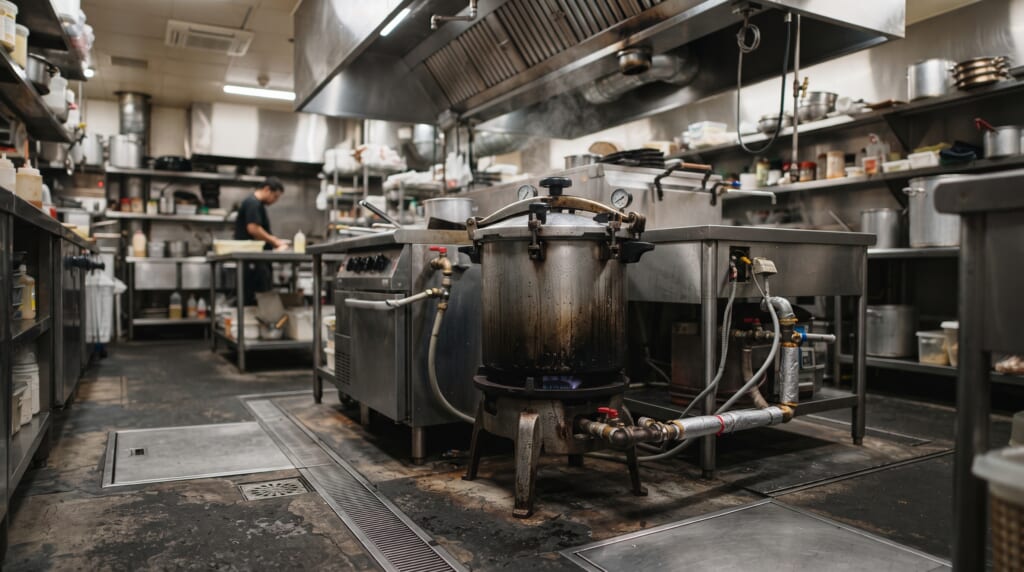
The space above the body is the easiest thing to overlook when installing a pressure cooker. Even if the body (990 mm high on the 130L model) fits neatly under the hood, the lid will hit the skirt of the exhaust hood and cannot be removed if there is not enough height to lift it and take it out at an angle. This has actually happened in kitchens.
Measure from the top of the burner (where the pot sits) to the bottom edge of the hood skirt, and check the difference from the body height. Because the lid comes off every day, a layout that forces staff to pull a heavy lid out at an awkward angle also strains their backs. Sideways, besides the body width (590–644 mm), make sure there is room to stand in front of the pot and transfer the broth.
Not sure whether your hood is high enough? Send the dimensions around your burner to Kitchen Techno.
[Check 3] Gas supply: a burner of 33,000 kcal/h or less is recommended
Meiwa Seisakusho recommends a burner of 33,000 kcal/h (about 38 kW) or less for its pressure cookers. How much time a pressure cooker saves depends on how quickly it boils and reaches pressure. With too little heat, it takes longer to build pressure, and the time savings shrink.
You can check your current burner’s output on its rating plate. Ask your gas supplier or equipment contractor whether your gas type (natural gas or LPG), pipe size and ventilation are suitable. Depending on the total output of the gas appliances in your kitchen, local regulations may require a notification to the fire authority, so it is worth checking at the same time.
[Check 4] Floor: no reinforcement needed—level matters more than weight
A standard restaurant floor does not need to be reinforced for a pressure cooker. Once water and ingredients go in, however, the weight rises well above the body alone. The 130L model weighs about 186 kg when filled with water up to the water line. For safe pressure cooking, install it on a flat floor with no significant slope.
[Check 5] Ventilation: place it under a standard exhaust hood
A pressure cooker does not require a dedicated duct. Still, it heats for a long time on a strong burner and releases steam when depressurizing, so the basic rule is a layout that places it under a standard commercial exhaust hood.
Before installation, confirm with Kitchen Techno which way the steam comes out, so that it is not directed at staff faces or toward a walkway.
3. “Isn’t high pressure dangerous?” The safety devices
Meiwa Seisakusho’s pressure cooker comes standard with dual safety valves, a pressure gauge and a pressure-release mechanism. After heating, the pressure is brought down by natural depressurization or water cooling before moving on to the next step. Because the pressure gauge shows the state of the pot at a glance, staff who take over the prep can easily see what is happening. The safety mechanism is explained in detail in Are Commercial Pressure Stockpots Safe?
Meiwa Seisakusho is a member of the Tempos Group and a specialist manufacturer that makes its pressure cookers in-house, from drawing development to finished product. It has more than 30 years of manufacturing experience and also manufactures to the international ASME standard.
4. Frequently asked questions
What is the minimum I should measure before installation?
Can I use my current gas burner?
Does the floor need to be reinforced?
Will it fit under my exhaust hood?
Who can I talk to before buying from overseas?
5. Summary: measure five places, then confirm with the actual unit
When installing a commercial pressure cooker, check five places: the delivery route, the space above for removing the lid, the burner output, the floor and the exhaust hood. Measure them in advance and you will not be caught out on delivery day by “it doesn’t fit” or “the lid won’t come off.” Cutting prep time to about half and consistently making rich broth of up to Brix 12% or more (with two-stage pressurization) starts with a tape measure.
When you want to confirm that the unit will really fit in your kitchen, bring your measurements and talk to us.
[Installation questions / overseas purchases, export and ASME]
For customers outside Japan, Kitchen Techno, Meiwa Seisakusho’s sales agent, is your point of contact. English support is available.
• Phone: Kitchen Techno +81-3-5285-3301 (10:00–17:00 Japan time, UTC+9)▼ Contact Kitchen Techno here
https://pressurecooker.pro/en/contact-en/