Table of Contents (click to open)
- Conclusion: choose the size by your daily batch volume
- 1. Pressure stockpot vs. regular stockpot
- 2. How to choose a size (50L, 90L, 110L, 130L)
- 3. Checklist for choosing without mistakes
- 4. Safety devices and the manufacturer
- 5. Frequently asked questions
- 6. Summary: decide the size by batch volume, then confirm the details
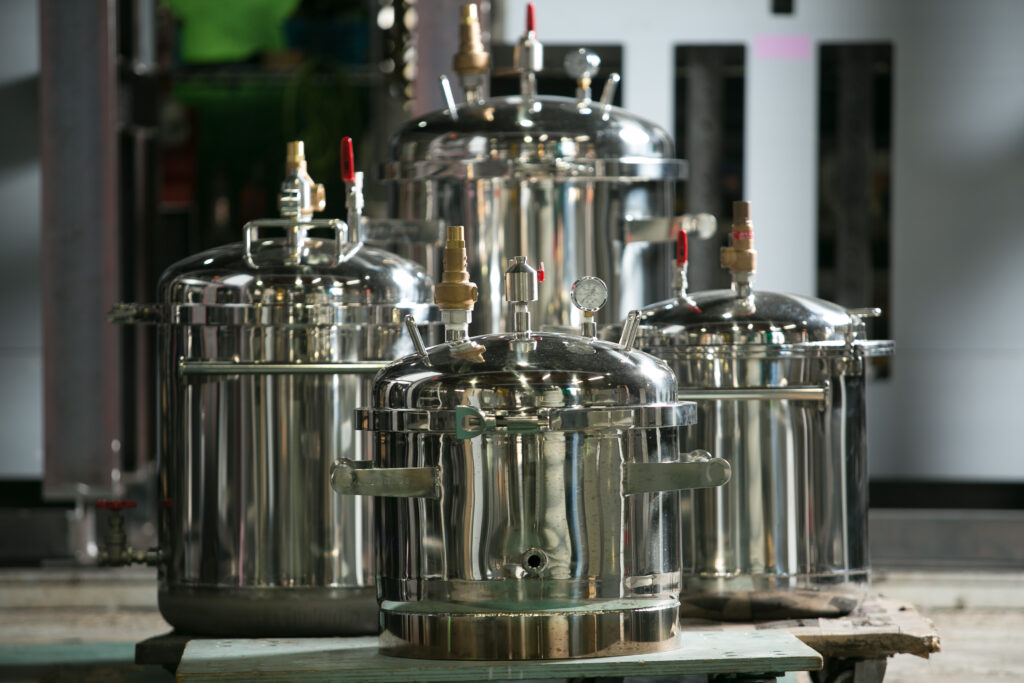
A commercial pressure cooker (pressure stockpot) is a large cooking vessel that uses high heat and pressure (about 120°C) to simmer broth for ramen shops and restaurants in a short time. It shortens tonkotsu simmering that used to take 10 hours or more in a regular stockpot, and cuts both the gas bill and the staff time spent standing over the pot. This guide explains how it differs from a regular stockpot and how to choose among the four sizes (50L, 90L, 110L, 130L), based on Meiwa Seisakusho’s product specifications.
Conclusion: choose the size by your daily batch volume
For Meiwa Seisakusho’s pressure stockpot, the basic rule is to choose the size by how much broth you prepare a day.
- Up to 40L a day: 50L (ramen specialty shops, small restaurants)
- 40–80L a day: 90L (typical ramen shops)
- More than that: 110L or 130L (chains, central kitchens)
If you cannot decide, the quickest route is to start with the versatile and most popular 90L model.
1. Pressure stockpot vs. regular stockpot
A pressure stockpot is a stockpot that seals the vessel and applies pressure to raise the boiling point to about 120°C. It cuts the long simmering that a regular stockpot at atmospheric pressure (about 100°C) needs to half the conventional time or less, and draws flavor out of the bones down to the marrow. Meiwa Seisakusho’s pressure stockpot emulsifies the broth automatically as it is drawn off through the transfer hose, so there is no stirring or straining, and the broth comes out consistent even without a skilled cook.
| Item | Regular stockpot | Commercial pressure stockpot (Meiwa Seisakusho) |
|---|---|---|
| Heating | Atmospheric pressure (about 100°C) | High pressure (about 120°C) |
| Prep time | Tonkotsu can take 10 hours or more | Half the conventional time or less |
| Broth concentration (Brix) | Varies with reduction (around 6–8%) | Up to 12% or more (two-stage pressurization) |
| Emulsification | Needs constant stirring by hand | Emulsifies automatically while the broth is drawn off through the transfer hose |
| Gas cost | Tends to run high | A 90L user cut it from ¥150,000 to ¥70,000 a month |
| Safety devices | No pressure involved | Dual safety valves, pressure gauge and pressure-release mechanism as standard |
Gas costs fall because the heat can be kept low once pressure is reached. At one shop using the 90L model, simmering that took 10 hours or more in a regular stockpot came down to about a quarter of the time. The longer a broth normally simmers, as with tonkotsu or chicken paitan, the bigger the difference in time and gas.
2. How to choose a size (50L, 90L, 110L, 130L)
Meiwa Seisakusho’s commercial pressure stockpot comes in four sizes, and the larger the model, the lower its working pressure. Start by finding the model closest to your batch volume in the table below.
| Model | Working pressure | Water capacity | Broth per batch (guide) | Best suited to |
|---|---|---|---|---|
| 50L | 0.3 MPa | 40L | approx. 20–25L | Ramen specialty shops, small restaurants |
| 90L | 0.2 MPa | 75L | approx. 40–55L | Mid-size ramen shops, multi-concept restaurants |
| 110L | 0.15 MPa | 100L | approx. 60–80L | Large ramen chains, central kitchens |
| 130L | 0.13 MPa | 120L | approx. 66–100L | Central kitchens, high-volume production |
50L: rich broth with bones fully broken down, even in a small shop
The 50L model cooks at the highest pressure in the series, 0.3 MPa (boiling point of 120°C or more), so its bone-crushing power and flavor extraction exceed the larger models. Each batch yields about 20–25L of broth—about 60–80 bowls at 300–400 ml per bowl. The lid and inner pot come apart, so one person can wash it in about 15–20 minutes.
90L: just right for a typical ramen shop’s daily prep
The 90L model makes 40–55L (about 100–150 bowls) per batch and offers the best balance of capacity and ease of handling, which is why it is the most popular size.
110L: cook in bulk and prep fewer days
The 110L model can make up to 80L (about 200–260 bowls) in one batch. Run it once every three days and rapidly chill and store the finished broth, and you can greatly reduce daily prep work. Its working pressure is 0.15 MPa, but its larger volume holds plenty of heat, so it breaks bones down just like the 90L model.
130L: three or four stockpots in one
The 130L model is the largest in the series and makes up to 100L of broth per batch. Because it replaces three or four regular stockpots, it helps keep down the cost of burners, exhaust hoods and kitchen space. In Japan, it is designed to fall within the legal category of a “small pressure vessel,” so no licensed boiler operator is required.
If you are torn between the 50L and 90L—for example, “we want to prepare about 60L a day”—send your batch volume and the number of bowls you serve to Kitchen Techno for an individual recommendation.
3. Checklist for choosing without mistakes
- Know your daily batch volume (L) (the most important criterion)
- Estimate bowls served and turnover at peak
- Check installation conditions such as kitchen space and gas supply (→ Pre-installation checklist: layout, dimensions, gas, ventilation and delivery route)
- Factor in the possibility of more stores or a central kitchen
- If unsure, start with the versatile 90L
4. Safety devices and the manufacturer
Meiwa Seisakusho’s pressure stockpot comes standard with dual safety valves, a pressure gauge and a pressure-release mechanism. After heating, the pressure is brought down by natural depressurization or water cooling, and the broth is moved to another container through the transfer hose, so nobody has to lift and tip a heavy pot. The safety mechanism is explained in Are Commercial Pressure Stockpots Safe?
Meiwa Seisakusho is a member of the Tempos Group and a specialist manufacturer that makes its pressure stockpots in-house, from drawing development to finished product. It has more than 30 years of manufacturing experience and also manufactures to the international ASME standard.
5. Frequently asked questions
How is a pressure stockpot different from a regular stockpot?
Which size should I choose?
Why is the 90L the most popular?
Can the 50L really break bones down completely?
How much can gas cost drop?
6. Summary: decide the size by batch volume, then confirm the details
The size of a commercial pressure stockpot comes down to your daily batch volume: 50L for up to 40L, 90L for 40–80L, and 110L or 130L beyond that. If you are unsure, using the popular 90L as your benchmark makes comparison easier. Cut prep time to about half, reduce gas and labor, and make the same broth every day without relying on one cook’s instincts—to choose the unit that does that for your shop, talk to Kitchen Techno with your numbers.
▼ See the products / request a quote
50L|90L|110L|130L
For international purchases, export, OEM and ASME, Kitchen Techno, Meiwa Seisakusho’s sales agent, is your point of contact (English support available).
• Phone: Kitchen Techno +81-3-5285-3301 (10:00–17:00 Japan time, UTC+9)
Contact us →