Table of Contents (click to open)
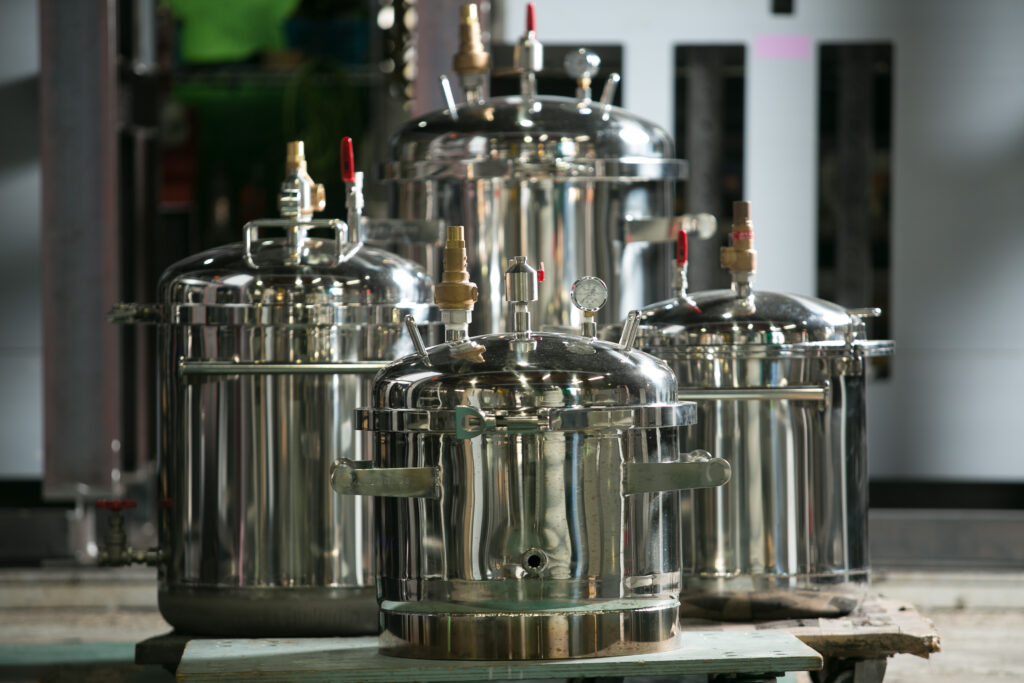
A commercial pressure cooker (pressure stockpot) is a large cooking vessel that uses high heat and pressure (about 120°C) to simmer ramen broth in a fraction of the usual time. This guide explains how a pressure stockpot differs from a regular stockpot, and how to choose among the four sizes (50L, 90L, 110L, 130L) — based on Meiwa Seisakusho’s specifications, your shop size, and your daily batch volume.
Pressure stockpot vs. regular stockpot
A pressure stockpot seals the vessel and raises the boiling point to about 120°C, cutting the long simmering that a regular stockpot (about 100°C) requires. Meiwa’s pressure stockpots shorten broth preparation to less than half the conventional time and extract umami down to the marrow. Automatic emulsification also reproduces a consistent, rich paitan broth without relying on an artisan’s heat control.
| Aspect | Regular stockpot | Pressure stockpot (Meiwa) |
|---|---|---|
| Heating | Atmospheric (~100°C) | High pressure (~120°C) |
| Prep time | Long | Half or less vs. conventional |
| Umami extraction | Mostly surface | Down to the marrow |
| Paitan consistency | Depends on artisan skill | Uniform via auto-emulsification |
| Gas cost | Tends to be high | Reduced (90L model: ¥150,000→¥70,000/month) |
Cooking stable broth quickly and with less energy is the main reason to choose a pressure stockpot. The gap in prep time and gas cost is especially large for long-simmer broths such as tonkotsu and chicken paitan.
How to choose a size (50L, 90L, 110L, 130L)
Meiwa’s commercial pressure stockpots come in four sizes. The selection axes are “shop size” and “daily batch volume.” Larger models are set to a lower working pressure. Use the table below as a guide, and check each model page for full specifications.
| Model | Working pressure | Best-suited shops / uses |
|---|---|---|
| 50L | 0.3 MPa | Specialty ramen shops and small restaurants. Ideal for up to 40L/day. |
| 90L | 0.2 MPa | Mid-size ramen shops. About 600–800 servings per batch. Most versatile and most popular. |
| 110L | 0.15 MPa | Large-capacity model for central kitchens and multi-store chains. |
| 130L | 0.13 MPa | The largest in the series. For large-batch production. |
If you are unsure, start with the versatile, most popular 90L model. If you have specific conditions (for example, “I want to prepare about 60L a day”), we can advise whether 50L or 90L fits best — just ask us.
A checklist for choosing without regret
- Know your daily batch volume (liters) — the most important criterion
- Estimate peak servings and table turns
- Check installation conditions: kitchen space, gas / power
- Factor in future multi-store or central-kitchen plans
- When in doubt, start from the versatile 90L
Frequently asked questions
How is a pressure stockpot different from a regular stockpot?
Which size should I choose?
Why is the 90L the most popular?
How much can gas cost drop?
Product lineup and inquiries
Full specifications for each model are on the product pages. For consultation and quotations on international purchases, export, OEM, and ASME, Kitchen Techno is your point of contact (English support available).
▼ See the products / request a quote
50L|90L|110L|130L / Contact us →