Table of Contents (click to open)
- In short: a commercial pressure cooker is the general term; a pressure stockpot is the type that cooks broth, draws it off from the bottom and emulsifies it
- 1. How does a commercial pressure cooker differ from a pressure stockpot?
- 2. Broth volume and how many bowls your shop serves
- 3. What do extraction and emulsification change in your prep?
- 4. Safety devices and rules once you start using one
- 5. Shops that can get by with a commercial pressure cooker, and shops suited to a pressure stockpot
- 6. How to compare them with your own shop’s broth
- FAQ
- Summary: the difference is broth volume, and how the broth is drawn off and emulsified
In short: a commercial pressure cooker is the general term; a pressure stockpot is the type that cooks broth, draws it off from the bottom and emulsifies it
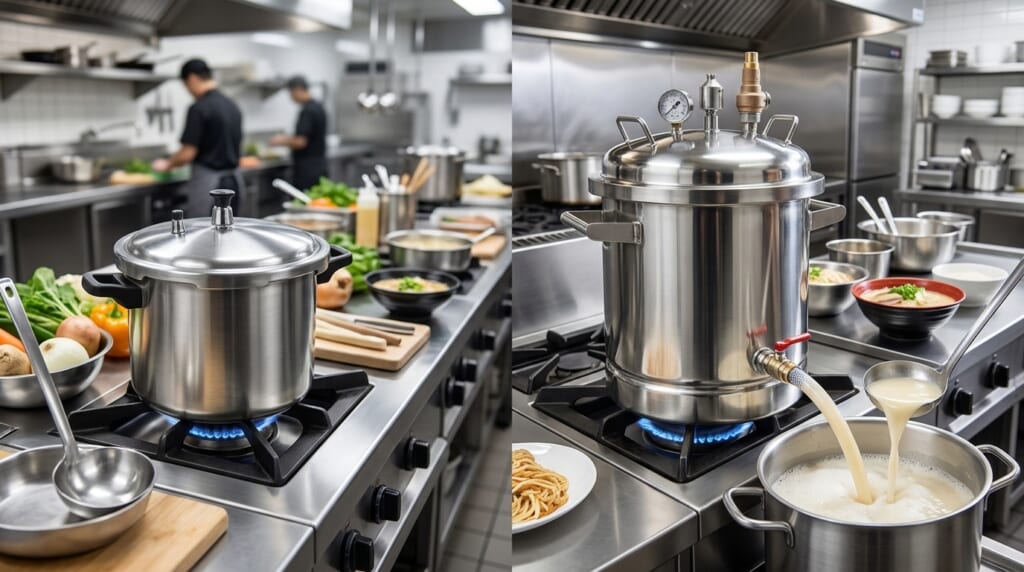
A commercial pressure cooker is the general term for the large pressure cookers used in restaurants and similar kitchens. A pressure stockpot is the stockpot-type model within that group, made to cook ramen broth in batches of tens of liters and to emulsify it as it is drawn off through a valve and hose at the bottom.
- Capacity: Meiwa Seisakusho’s pressure stockpots come in four sizes, 50 to 130 L, and cook about 20 to 100 L of broth per batch
- Extraction: With a typical commercial pressure cooker, broth is mostly ladled out from the top. A pressure stockpot draws it off through a bottom valve and a dedicated liquid transfer hose
- Emulsification: With a typical commercial pressure cooker, you stir by hand after heating. A pressure stockpot emulsifies the broth automatically and forcibly as it is drawn off
- Shops that can get by with a commercial pressure cooker: Shops that make small amounts of broth, or whose menu centers on stews and non-emulsified broth
You started looking at commercial pressure cookers to shorten broth prep. Then the term “pressure stockpot” came up, and you could no longer tell what the difference was. If a commercial pressure cooker is enough, why bring in a big stockpot at all?
Both a commercial pressure cooker and a pressure stockpot cook at a higher temperature under pressure, but they differ in the amount of broth, how the cooked broth is taken out, and how it is emulsified. Meiwa Seisakusho, which makes pressure stockpots, explains the differences and how to choose the one that suits your shop, based on our comparison table.
1. How does a commercial pressure cooker differ from a pressure stockpot?
The difference lies in what each is designed to cook, and how much. A commercial pressure cooker is a pot for cooking many kinds of dishes quickly under pressure, from stews to stock, and its size and construction vary by product. A pressure stockpot is designed so that one pot handles the whole sequence of a ramen shop’s daily broth prep: cooking a large quantity of bones, taking the broth out safely and emulsifying it.
Pulling the differences between a typical commercial pressure cooker and Meiwa Seisakusho’s pressure stockpot out of the comparison table on our top page gives the following.
| Item | Typical commercial pressure cooker | Meiwa Seisakusho pressure stockpot |
|---|---|---|
| Cooking time | About 2 to 3 hours | About 2 hours to 2.5 hours (in-house results) |
| Prep of pork knuckle bones (genkotsu) | May need to be cut beforehand, depending on the size of the opening | Can be put in whole, uncut |
| Softening of bones | Softened to some degree | Softened until they break by hand (2 atm, 120°C / 248°F) |
| Broth concentration (Brix) | About 8 to 10% | Up to 12% or more (two-stage pressurization, in-house results) |
| Emulsification | Stirred by hand after heating | Emulsified automatically and forcibly as the broth is drawn off through the dedicated hose |
| Drawing off the broth | Mostly ladled out from the top | Drawn off through a bottom valve and a dedicated liquid transfer hose |
| Standardizing prep | Can be managed with a timer | Steps can be standardized by pressurizing time and valve operation |
| Gas use | Lower, because cooking time is shorter | Can be kept on low heat once the set pressure is reached |
| Bones after cooking | Volume reduced somewhat | Broken down finely; the volume to discard is greatly reduced |
| Safety devices and pressure control | Standard safety valve | Double safety valves, pressure gauge and pressure-release mechanism as standard |
*The “typical commercial pressure cooker” column describes the general construction and specifications of standard products on the market as a guide for comparison; it is not data for any specific product. Cooking time, Brix and gas use are results from our test environment with a specific standard recipe, and vary with the cut of bones, quantity, heat and conditions of use.
*If the table is cut off, scroll sideways.
Source: Meiwa Seisakusho official site, comparison table on the top page (checked November 5, 2026)
As the table shows, cooking time does not differ greatly between a typical commercial pressure cooker and a pressure stockpot. The larger differences are not in time but in the steps specific to ramen broth: preparing the bones, concentration, emulsification and how the broth is drawn off.
2. Broth volume and how many bowls your shop serves
When choosing a commercial pressure cooker, first check whether the amount of broth one batch makes is enough for your shop’s daily bowl count. If one batch is not enough, you end up cooking several times a day, and the time you saved with pressure is offset by the number of batches.
| Meiwa Seisakusho pressure stockpot | Water capacity | Broth per batch (guide) | Bowls (guide) |
|---|---|---|---|
| 50L | 40 L | About 20–25 L | About 60–80 bowls |
| 90L | 75 L | About 40–55 L | About 100–150 bowls |
| 110L | 100 L | About 60–80 L | About 200–260 bowls at the maximum of 80 L |
| 130L | 120 L | About 66–100 L | About 250–330 bowls at the maximum of 100 L (calculated) |
*Bowl counts are a guide, assuming 300–400 ml of broth per bowl. The 130L product page gives no bowl count, so it is calculated from the maximum amount.
Source: Meiwa Seisakusho product pages (50L, 90L, 110L, 130L): specifications and FAQ (checked November 5, 2026)
How to choose a size is explained in “How to Choose a Commercial or Industrial Pressure Cooker: Large 50–130L Models vs. a Regular Stockpot.”
3. What do extraction and emulsification change in your prep?
The bottom valve and liquid transfer hose of a pressure stockpot let you move finished broth into another container without lifting the heavy pot. With Meiwa Seisakusho’s 130L model, even 100 L of broth can be moved to another stockpot or storage tank in about 3 to 5 minutes. Because you no longer ladle broth out from the top dozens of times or tilt a hot pot, the risk of burns and the strain on your back are reduced.
Emulsification also happens as the broth is drawn off through this hose. White, rich tonkotsu and chicken paitan broths need emulsification, in which the fat and water from the bones are mixed finely, and normally you have to keep stirring by hand while cooking or afterward. Because a pressure stockpot emulsifies the broth forcibly as it is drawn off, even people without years of experience can get a consistent level of emulsification more easily.
Conversely, when you want a clear chintan broth, you can change how the valve is opened and how pressure is released, and take it out without emulsifying it. How to make chintan and paitan separately is explained in “Chintan vs Paitan: How Pros Make Both with Valve and Pressure Control in a Pressure Cooker.”
4. Safety devices and rules once you start using one
Whichever pot you choose, a pot that is put under pressure calls for checking its safety devices and the rules for using it. Meiwa Seisakusho’s pressure stockpot comes with double safety valves, a pressure gauge and a pressure-release mechanism as standard.
Shops that have adopted one also set safety rules of their own. The owner of the chicken paitan specialty shop 麺屋 野条 (Nishinomiya, Hyogo), Mr. 野条 (野条 岳), says he makes sure staff never open the lid while the pot is pressurized and always check the pressure gauge.
Rules for pressure vessels differ by destination country and state. In regions such as North America that use the ASME BPVC Section VIII Division 1 standard, Meiwa Seisakusho can build pressure stockpots to that standard (please consult Kitchen Techno). If you are considering another commercial pressure cooker, check its pressure-vessel classification and inspection requirements with the seller.
The safety devices are explained in “Are Commercial Pressure Stockpots Safe? Safety Valves, Residual-Pressure Valves, and Broth Automation Anyone Can Run.” For the ASME standard required in export destinations, see “ASME Pressure Vessel Code for Ramen Shops Abroad: What to Check and How to Make the Same Broth Overseas.”
5. Shops that can get by with a commercial pressure cooker, and shops suited to a pressure stockpot
Not every shop needs a pressure stockpot. Depending on the amount and type of broth you cook, a typical commercial pressure cooker may be enough.
| Your shop | Better suited | Reason |
|---|---|---|
| You cook little broth per day (under 20 L per batch) | Commercial pressure cooker | Even Meiwa Seisakusho’s smallest 50L model is designed to cook about 20–25 L of broth per batch, so if your volume is mostly smaller than that, a smaller pot is easier to handle |
| Your menu centers on stews or non-emulsified broth | Commercial pressure cooker | You would seldom use the emulsification that happens as the broth is drawn off |
| You cook rich white broth such as tonkotsu or chicken paitan every day | Pressure stockpot | Knuckle bones can go in uncut, the broth is emulsified as it is drawn off, and it is easier to keep the richness consistent |
| You want staff to take over broth prep | Pressure stockpot | Steps can be standardized by pressurizing time and valve operation, and the broth can be drawn off without lifting a heavy pot |
| You serve 100 or more bowls a day, or cook for several shops | Pressure stockpot (90L or larger) | One batch can cook 40 L or more of broth |
*If the table is cut off, scroll sideways.
If you are unsure which suits you, write down your current daily bowl count and the type of broth you cook, then consult us; it makes it easier to decide, including the size.
6. How to compare them with your own shop’s broth
The difference between a commercial pressure cooker and a pressure stockpot becomes clear when you cook with your own bones and recipe. If you plan to visit Japan, you can bring the bones and ingredients you use to the test kitchens in Tokyo and Osaka and try them on an actual unit (reservation required). Purchases, export, OEM and ASME inquiries from outside Japan are handled by Kitchen Techno, our sales agent, with English support.
Meiwa Seisakusho is a member of the Tempos Group and a specialist manufacturer that builds pressure stockpots in-house, from drawings through production. With more than 30 years of manufacturing experience, it also inspects every unit before shipment. Some owners weigh not only price but also whether they can test a unit and how well the maker responds to questions when comparing manufacturers. The owner of 麺屋 野条 also names the attentive support he received, after comparing the prices of other manufacturers, as what decided it for him.
FAQ
Can Meiwa Seisakusho’s pressure stockpot run on electricity?
What does a commercial pressure cooker cost besides the unit itself?
Do recipes change when you switch from a typical commercial pressure cooker to a pressure stockpot?
Summary: the difference is broth volume, and how the broth is drawn off and emulsified
Cooking time does not differ greatly between a commercial pressure cooker and a pressure stockpot. The difference shows up in how much broth one batch makes, and in the mechanism that draws the finished broth off from the bottom and emulsifies it.
First write down your daily bowl count and the type of broth you cook, and check them against the table in section 5 of this article. If you fall in the column for a pressure stockpot, the next step is to consult Kitchen Techno and compare it with your own bones (at the test kitchens, if you plan to visit Japan).
▼ Inquiries about trials and quotes
For customers outside Japan, Kitchen Techno, Meiwa Seisakusho’s sales agent, is your point of contact (English support available). If you plan to visit Japan, trials at the test kitchens in Tokyo and Osaka are also possible (reservation required).
• Phone: Kitchen Techno +81-3-5285-3301 (10:00–17:00 Japan time, UTC+9)
https://pressurecooker.pro/en/contact-en/