Table of Contents (click to open)
- Conclusion: the first step of kitchen DX is turning broth prep into a process set in numbers
- Why prep that relies on a chef’s intuition becomes a business risk
- Why a pressure stockpot turns prep into a process set in numbers
- Check the result by Brix to reduce day-to-day and shop-to-shop differences
- How prep set in numbers affects costs
- Frequently asked questions
- Summary: putting prep into numbers protects both profit and people
Conclusion: the first step of kitchen DX is turning broth prep into a process set in numbers
Kitchen DX for a ramen shop does not have to start with installing an expensive system. The first step is to replace broth prep that relied on a chef’s intuition with a procedure set in numbers. With a Meiwa Seisakusho pressure stockpot, the amounts of bones and water, the pressurizing time and the valve operation can all be set as numbers, so a simmer that usually takes 8–12 hours is cut to about 2–2.5 hours and follows the same flow every time.
With rising ingredient and utility costs on top of labor shortages, more shops are rethinking how they prep. Once broth prep can be managed by numbers, it pays off in three areas: gas costs, prep time and staff training.
Why prep that relies on a chef’s intuition becomes a business risk
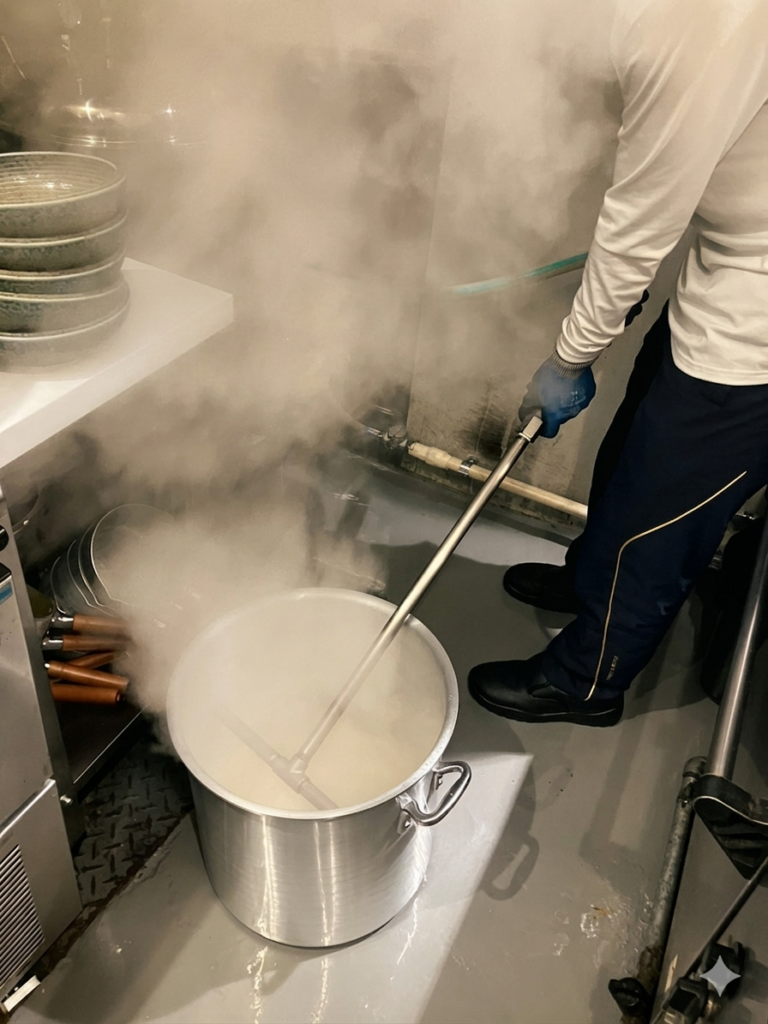
Making broth in a regular stockpot means simmering on a high flame for a long time, stirring to prevent scorching, and finishing while watching the heat and topping up water. When to do what depends on the chef’s experience and feel.
Done this way, the flavor tends to change when a particular person is absent, and teaching new staff takes time. Long hours spent coming in early for prep or watching the pot late at night also weigh on both labor costs and hiring.
Why a pressure stockpot turns prep into a process set in numbers
Meiwa Seisakusho’s commercial pressure stockpot has a fixed prep flow built in, which makes the procedure easy to write down in numbers.
Five steps, the same flow every time
Prep with a Meiwa Seisakusho pressure stockpot takes five steps: “add ingredients → close the lid and heat → hold pressure on low heat → depressurize and cool → draw off through the transfer hose.” Once the model’s working pressure is reached (50L: 0.3 MPa, 90L: 0.2 MPa, 110L: 0.15 MPa, 130L: 0.13 MPa), you switch to low heat and hold it for the set time.
Sealed cooking means no need to look inside midway
For safety, the lid of a pressure stockpot cannot be opened while it cooks under pressure. In exchange, because it cooks sealed, setting the same time and heat each time keeps the result from drifting without checking inside. It also rarely gives off heavy steam during cooking.
A double structure prevents scorching, so no one has to stand stirring
Inside the pressure stockpot is a double structure with a perforated inner pot (basket). Solids such as bones and meat never touch the heated bottom directly, so even thick broth does not scorch and there is no need to keep stirring while it cooks.
The broth emulsifies as it is drawn off through the transfer hose
Finished broth can be moved to another container through the bottom valve and a dedicated transfer hose. The broth emulsifies automatically as it is drawn off, eliminating the steps of lifting a heavy pot to strain it or stirring by hand. With the 130L model, even 100L of broth is transferred in about 3–5 minutes.
Check the result by Brix to reduce day-to-day and shop-to-shop differences
Brix is a value showing the concentration of dissolved substances in a liquid, and is used as a guide to broth strength. Setting the process in numbers and also checking the finished broth by Brix lets you notice differences such as “a little thin today” early.
In Meiwa Seisakusho’s tests, broth from a regular stockpot varied at around 6–8% Brix depending on how far it was reduced, while the pressure stockpot reached 12% or more with two-stage pressurizing (results in the company’s test environment). If each shop sets a target Brix, new staff can be told in numbers when the broth is done.
How prep set in numbers affects costs
Once prep can be managed by numbers, three costs become easier to reduce: gas, prep time and training.
Gas: low heat is enough once pressurized
A pressure stockpot can run on low heat after reaching the specified pressure, so there is no need to keep a high flame going for hours. At one shop that introduced Meiwa Seisakusho’s 90L model, the gas bill for tonkotsu broth went from ¥150,000 to ¥70,000 a month. A difference of ¥80,000 a month adds up to ¥960,000 a year. The thinking behind gas costs is covered in detail in concrete ways to halve the gas bill for simmering ramen broth.
Prep time: 8–12 hours becomes about 2–2.5 hours
A simmer that takes about 8–12 hours in a regular stockpot finishes in about 2–2.5 hours in a pressure stockpot (Meiwa Seisakusho’s in-house results). There is no need to stand by the flame stirring either, so early starts and overtime just for broth go down and that time can go to other work. The link to labor shortages is covered in why a pressure stockpot eases ramen shop labor shortages.
Training and multi-store growth: teach with a manual and numbers
Putting the amounts of bones and water, the pressurizing time, the valve operation and the target Brix into a manual lets you teach less experienced staff to the same standard. The flavor holds more easily even when the owner is not at the pot every day, laying the groundwork for a second or third shop.
Frequently asked questions
What does “kitchen DX” mean here?
How much do gas costs go down with a pressure stockpot?
How much shorter does prep become?
What is the benefit of managing broth by Brix?
Can I try it with my own recipe?
Summary: putting prep into numbers protects both profit and people
Ramen is a craft where a chef’s skill matters, but keeping a shop going for years requires both a system that leaves a profit and a sustainable way of working. Turning broth prep into a process set in numbers is a realistic first step toward that.
- Gas: hold on low heat after pressurizing and stop hours of high-flame cooking.
- Prep time: shorten an 8–12 hour simmer to about 2–2.5 hours.
- Quality and training: set the process and Brix in numbers so the flavor stays close to the same whoever cooks.
If you want to know how much time and gas would change if your broth were made in a pressure stockpot, please contact us.
▼ Inquiries about trials and quotes
For customers outside Japan, Kitchen Techno, Meiwa Seisakusho’s sales agent, is your point of contact (English support available).
• Phone: Kitchen Techno +81-3-5285-3301 (10:00–17:00 Japan time, UTC+9)
https://pressurecooker.pro/en/contact-en/