Table of Contents (click to open)
- ■ Conclusion: cut the time and the “standing guard,” and staff shortages ease
- ■ Why is prep at a ramen shop so grueling?
- ■ Three reasons a pressure stockpot makes prep lighter
- ■ Turn a cook’s instinct into a system that brings anyone closer to the same flavor
- Frequently asked questions
- ■ Wondering “how much easier would it be with our broth?”
■ Conclusion: cut the time and the “standing guard,” and staff shortages ease
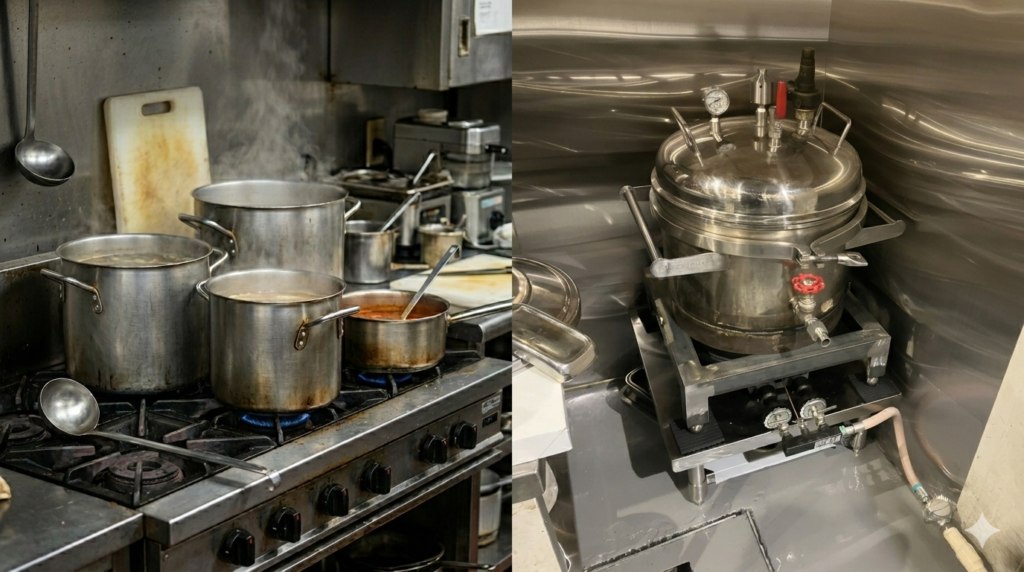
The quickest way to ease staff shortages at a ramen shop is to cut the time spent on broth prep and the time spent standing over the pot. Meiwa Seisakusho’s pressure stockpot shortens simmering that normally takes about 8–12 hours to about 2 to 2.5 hours, and removes the need to stand at the flame stirring.
■ Why is prep at a ramen shop so grueling?
Arriving early, hauling kilos of heavy bones, watching the broth at the burner for hours… For a ramen shop, broth prep is the most important job and also the most exhausting.
In summer, the heat and steam from several stockpots turn the kitchen into a sauna. “Staff won’t last in conditions this tough.” “We advertise, but the hours are so long nobody applies.” Many owners are stuck in this loop of staff shortages.
The key to easing both the tough working conditions and the heavy labor cost at once is changing how you cook the broth.
■ Three reasons a pressure stockpot makes prep lighter
With Meiwa Seisakusho’s commercial pressure stockpot, the time and physical strain of prep become lighter in three ways.
- ① Shorter cooking means fewer early starts and less overtime
Tonkotsu broth that takes about 8–12 hours in an ordinary stockpot finishes in about 2 to 2.5 hours in a pressure stockpot (Meiwa Seisakusho’s company results). Because it cooks at about 120°C, bones soften until they break by hand, giving up their flavor down to the marrow. You spend less time coming in early or staying late just to mind the broth. - ② No need to “watch it constantly,” so staff can do other work
With an ordinary stockpot, someone has to stay at the flame, stirring to keep the bottom from scorching and watching for boil-overs. A pressure stockpot’s inner pot keeps solids off the bottom of the vessel to prevent scorching, and once pressure is reached you simply switch to low heat and hold it for the set time. Meanwhile, staff can move on to other work such as getting ready for service. - ③ Less lifting of heavy pots and less washing
Finished broth is moved to another container through the transfer hose, so nobody has to lift and tip a heavy pot. The lid and inner pot come off for washing, so one person can clean the 50L model in about 15–20 minutes. The large 130L model replaces three or four regular stockpots, so there are fewer pots to wash too.
Because it cooks sealed, it rarely gives off heavy steam during cooking. Less steam hanging in the kitchen is welcome news for the staff who stand there every day.
■ Turn a cook’s instinct into a system that brings anyone closer to the same flavor
A pressure stockpot also reduces variation in flavor. Until now, the usual flavor depended on a veteran cook adjusting the flame and timing. With a pressure stockpot, prep follows five fixed steps, and the amounts of bones and water and the pressurization time can be set as numbers, so even part-time staff can get closer to the same flavor.
The owner of Menya Nojo, a chicken paitan specialty shop in Japan, says that for anyone who wants to hand prep over to staff or open more shops, a pressure stockpot makes training more consistent (customer interview video, in Japanese). It eases the owner’s worry that “the flavor will change unless I’m always in the shop,” and helps you grow to a second and third shop.
Frequently asked questions
Will a pressure stockpot reduce early starts and overtime?
Does someone have to watch it the whole time?
Is washing up easier?
Can part-time staff make the same broth?
Can I test it with my own broth?
■ Wondering “how much easier would it be with our broth?”
“Can our hearty tonkotsu really be made well in so little time?”
It is only natural to wonder.
That is why, at the test kitchens in Tokyo and Osaka, you can bring the ingredients you use in your shop and watch the broth being made in front of you.
Rethink the idea that “prep is just tough,” and take a step toward a shop where staff stay for the long run.
▼ Test cooking and overseas inquiries
For customers outside Japan, Kitchen Techno, Meiwa Seisakusho’s sales agent, is your point of contact (English support available).
• Phone: Kitchen Techno +81-3-5285-3301 (10:00–17:00 Japan time, UTC+9)
https://pressurecooker.pro/en/contact-en/