Table of Contents (click to open)
- ■ Conclusion: the key to less flavor variation is deciding how broth is made by numbers
- ■ More shops is exciting! But what if people say “it tastes different from the flagship”?
- ■ The cause: broth-making that relies on a cook’s instinct and experience
- ■ Three reasons a pressure stockpot brings broth closer to the same flavor
- ■ It also works as a central kitchen (broth plant)
- Frequently asked questions
- ■ Why not try a multi-shop simulation?
■ Conclusion: the key to less flavor variation is deciding how broth is made by numbers
The key to reducing flavor variation when you open more shops is to decide how the broth is made by numbers, not by a cook’s instinct. Meiwa Seisakusho’s pressure stockpot follows five steps with set amounts of bones and water, pressurization time and heat, so the flagship’s method can be handed to other shops as a recipe.
■ More shops is exciting! But what if people say “it tastes different from the flagship”?
Plenty of ramen owners, with a busy first shop, decide “Right, time for a second and a third!” But many hit the same wall as the number of shops grows: the ramen tastes different depending on the shop and the staff who make it (flavor variation).
If someone writes online, “The flagship is great, but the new shop’s broth is thin,” the whole brand suffers. Yet for you, the owner, or a veteran cook to visit every shop every day to check the broth is simply not sustainable.
■ The cause: broth-making that relies on a cook’s instinct and experience
Flavor differs between shops because conventional stockpot broth-making relies on invisible skills—a cook’s instinct and experience—for adjusting the flame, skimming and timing the stirring.
Reduction also changes with the day’s temperature and humidity, so even the same person cannot make it the same every day. Entrusting “our usual flavor” to new part-timers or less experienced staff is very hard. Expanding to more shops needs a system that brings anyone close to the same flavor.
■ Three reasons a pressure stockpot brings broth closer to the same flavor
① It cooks sealed, so it is little affected by the environment
A pressure stockpot cooks with the lid closed and sealed, so water hardly escapes into the air as it does in an open stockpot. Because temperature, humidity and ventilation have little effect on the reduction, fixing the amounts of bones and water lets different shops cook under similar conditions.
② Five fixed steps that can be written down as a numerical recipe
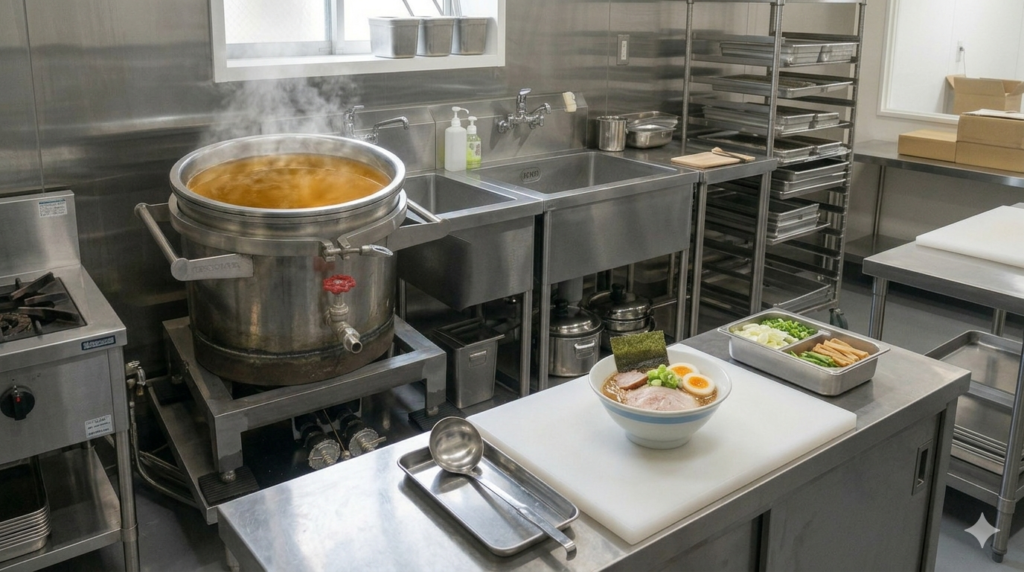
Prep with Meiwa Seisakusho’s pressure stockpot follows five steps: ① load the ingredients → ② close the lid and heat → ③ hold the pressure on low heat → ④ depressurize and cool → ⑤ draw off the broth through the transfer hose. The working pressure is fixed for each model, and the pressure gauge shows the state at a glance. Set the amounts of bones and water, the pressurization time and the heat as numbers, and the flagship’s method can be handed straight to other shops.
③ The tasks where people differ most disappear
Flavor variation tends to come from tasks such as stirring and straining, which everyone does a little differently. A pressure stockpot needs no stirring because its inner pot keeps solids off the bottom, and the broth emulsifies as it is drawn off through the transfer hose, so there is no straining either.
The owner of Menya Nojo, a chicken paitan specialty shop in Japan, says that for anyone who wants to hand prep over to staff or open more shops, a pressure stockpot makes training more consistent, because time, numbers and the strength of the gas can all be fixed instead of left to feel (customer interview video, in Japanese).
■ It also works as a central kitchen (broth plant)
As the number of shops grows, a central kitchen that makes broth for all shops in one place becomes an option. Meiwa Seisakusho’s 110L and 130L models are designed for large chains and central kitchens.
- 110L model: makes up to 80L (about 200–260 bowls) per batch, so you can cook once every three days and rapidly chill and store the broth.
- 130L model: the largest in the series, making up to 100L per batch. It replaces three or four regular stockpots, and under Japanese regulations it is designed to fall within the category of a “small pressure vessel,” so in Japan no licensed boiler operator is required.
Making broth in one place means each shop no longer needs rows of stockpots and burners, freeing up kitchen space. Bringing prep staff together in one location also makes labor more efficient. For how to decide between shop-by-shop and central cooking, see also How to Choose a Commercial Pressure Cooker.
Frequently asked questions
How can I prevent flavor variation when opening more shops?
Can it be used in a central kitchen?
Can inexperienced staff make it the same way?
Should each shop have one, or should broth be made in a central kitchen?
Can I test whether my recipe can be reproduced?
■ Why not try a multi-shop simulation?
“Can anyone really get close to our flavor with our complex recipe?”
“If we add shops, how should we design the kitchens?”
If you are thinking a step ahead, talk to us. At the test kitchens in Tokyo and Osaka, you can actually cook broth with your own recipe and see the result.
From a cook’s instinct to a system that brings anyone close to the same flavor—let’s shape your next step in expansion together.
▼ Multi-shop expansion, broth reproduction and overseas inquiries
For customers outside Japan, Kitchen Techno, Meiwa Seisakusho’s sales agent, is your point of contact (English support available).
• Phone: Kitchen Techno +81-3-5285-3301 (10:00–17:00 Japan time, UTC+9)
https://pressurecooker.pro/en/contact-en/