Table of Contents (click to open)
- Conclusion: at 120°C, changes in bones and collagen happen faster, drawing out umami and body in less time
- Why applying pressure lets you cook above 100°C
- What changes in the broth when the temperature rises by 20°C
- Emulsification: how water and fat mix
- Umami and off-flavors: the effect of cooking sealed
- Frequently asked questions
- Summary: flavor is decided by the changes in the pot, not by time
Conclusion: at 120°C, changes in bones and collagen happen faster, drawing out umami and body in less time
The reason a pressure stockpot makes good broth is that it can cook at about 120°C, above 100°C. In general, the higher the temperature, the faster bones soften and collagen turns into gelatin. Meiwa Seisakusho’s commercial pressure stockpot uses this temperature to cut a simmer that usually takes 8–12 hours to about 2–2.5 hours (in-house results).
Broth-making has long relied on a chef’s experience and intuition, but what happens in the pot is a set of changes: umami, fat and collagen dissolve from bones and meat into the water, and water and fat mix together (emulsify). This article looks at those changes in terms of temperature and pressure.
Why applying pressure lets you cook above 100°C
The temperature at which water boils (its boiling point) changes with the surrounding pressure. The higher the pressure, the hotter water must get before it boils.
An open stockpot levels off at about 100°C
A regular stockpot without a lid cooks at atmospheric pressure. At atmospheric pressure water boils at about 100°C, so however strong the flame, the broth stops at about 100°C and the extra heat leaves as steam.
A pressure stockpot cooks sealed at about 120°C
A pressure stockpot is a commercial cooking tool that can cook above 100°C by closing and sealing the lid and building pressure inside. Meiwa Seisakusho’s pressure stockpot cooks broth at about 120°C at the working pressure fixed for each model (50L: 0.3 MPa, 90L: 0.2 MPa, 110L: 0.15 MPa, 130L: 0.13 MPa). Double safety valves, a pressure gauge and a pressure-release mechanism come as standard.
What changes in the broth when the temperature rises by 20°C
The difference between 100°C and about 120°C is only around 20°C, but it makes a big difference to the broth ingredients.
Bones soften and the marrow dissolves more easily
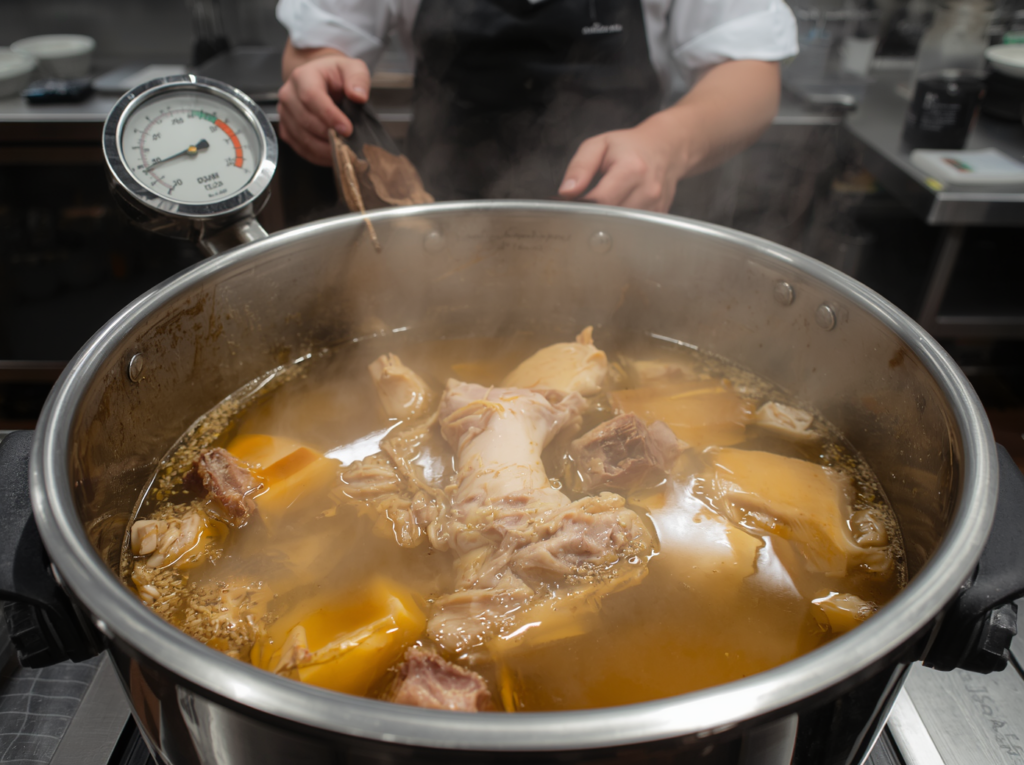
To make a rich broth from pork or chicken bones, hard bones must be softened so that the marrow and fat inside dissolve. At about 100°C, thick bones soften only gradually from the outside. In Meiwa Seisakusho’s pressure stockpot, cooking at about 120°C softens even pork leg bones enough to snap by hand, making it easier for the inside of the bone to dissolve into the broth.
Collagen turns into gelatin, giving thickness and body
Collagen, abundant in trotters, skin and chicken carcasses, is a protein that does not readily dissolve in water as it is. With continued heating it turns into gelatin and dissolves, giving the broth its thickness and body. This change also happens faster at higher temperatures, so a pressure stockpot makes it easier to get a thick broth in a short time. In Meiwa Seisakusho’s tests, two-stage pressurizing produced broth of up to 12% Brix (concentration) or more (results in the company’s test environment).
Emulsification: how water and fat mix
Emulsification is the phenomenon in which water and fat, which normally do not mix, blend evenly through heating and the action of collagen. The whiteness and creaminess of paitan come from this emulsification.
Gelatin acts as a go-between for water and fat
When fat breaks into fine droplets surrounded by gelatin and other substances dissolved from the bones, the fat stays dispersed in the water and is less likely to float. In a regular stockpot, this state has been created by boiling hard and stirring for hours while crushing the bones.
A pressure stockpot emulsifies the broth as it is drawn off through the transfer hose
With a Meiwa Seisakusho pressure stockpot, broth in which gelatin has dissolved well under pressure at about 120°C emulsifies automatically as it is drawn off through the transfer hose. It becomes a paitan with fat and water mixed together without hours of stirring. How to make clear chintan instead is covered in how to make chintan and paitan with valve and pressure control.
Umami and off-flavors: the effect of cooking sealed
Besides the temperature of about 120°C, cooking sealed with the lid closed also affects the taste of the broth.
Aroma is less likely to escape with the steam
A pressure stockpot cooks sealed, so it rarely gives off heavy steam during cooking. Aroma does not keep escaping with steam for hours as it does from an open stockpot.
Scum tends to stick to the walls and is less likely to mix into the broth
In a Meiwa Seisakusho pressure stockpot, scum tends to stick to the inner walls of the pot while pressurizing and is less likely to mix into the broth. There is no need to keep skimming for hours as with a regular stockpot, and the scum on the walls can be washed off with a sponge and detergent after cooking.
Combine ingredients with umami synergy in mind
Combining different umami compounds, such as glutamic acid (kombu, vegetables) and inosinic acid (meat, katsuobushi), makes umami taste stronger than either alone. This is called umami synergy. When cooking in a pressure stockpot too, you can adjust the depth of umami through the vegetables and dried ingredients you pair with the bones.
Frequently asked questions
At what temperature does a pressure stockpot cook broth?
Why does cooking at 120°C take less time?
Doesn’t cooking hot and fast bring out harshness or off-odors?
Can a pressure stockpot make paitan (emulsified broth)?
Can I check the difference of broth cooked at 120°C for myself?
Summary: flavor is decided by the changes in the pot, not by time
Broth simmered for a long time tastes good not because of time itself, but because over that time the bones soften, collagen turns into gelatin, and fat and water mix together.
A pressure stockpot is a cooking tool that uses a temperature of about 120°C to move those changes along in a short time. It lets you shorten prep while getting closer to the thickness and body you are aiming for.
If you want to see how broth cooked at 120°C differs from your usual broth, please contact us. How to use it specifically for tonkotsu is also covered in key points for making the tonkotsu broth you want in a pressure stockpot.
▼ Inquiries about trials and quotes
For customers outside Japan, Kitchen Techno, Meiwa Seisakusho’s sales agent, is your point of contact (English support available).
• Phone: Kitchen Techno +81-3-5285-3301 (10:00–17:00 Japan time, UTC+9)
https://pressurecooker.pro/en/contact-en/