Table of Contents (click to open)
- Conclusion: before going overseas, prepare a code-compliant pressure stockpot and a prep procedure set in numbers
- Regulations on pressurized kitchen equipment, a common stumbling block abroad
- What is the ASME Code (BPVC)? A code covering pressure vessels from design to inspection
- What Meiwa Seisakusho can provide
- Making the same broth with local staff: a prep procedure set in numbers
- Frequently asked questions
- Summary: make checking the code and building procedures the first step of preparing a shop
Conclusion: before going overseas, prepare a code-compliant pressure stockpot and a prep procedure set in numbers
When taking a ramen shop overseas, two things are worth preparing early: a pressure stockpot that meets local regulations, and a prep procedure that lets local staff make the same broth. Meiwa Seisakusho can manufacture pressure stockpots to ASME BPVC Section VIII, Division 1, the standard used for pressure vessels in North America and elsewhere, and its design makes it easy to turn prep into numbers through pressurizing time and valve operation.
Japanese ramen is popular abroad, and many owners are considering shops in North America, Asia, the Middle East and beyond. Yet some only realize after preparations are under way that the kitchen equipment they use in Japan cannot necessarily be used as-is overseas.
Regulations on pressurized kitchen equipment, a common stumbling block abroad
To use pressurized cooking equipment such as a pressure stockpot overseas, it must meet the regulations of the destination country or region. North America and some other countries and regions require pressure vessels to comply with the ASME Code.
Requirements vary by country, state and equipment
Which documents and inspections are needed depends on the country or state and the conditions of the equipment installed. If an equipment code issue comes to light after the premises and interior are well advanced, the equipment may have to be reconsidered at inspection, and the opening may be pushed back.
Rent and staff wages start before opening. It is safest to confirm the code for your pressure stockpot together with the destination’s requirements as early as you look for premises.
What is the ASME Code (BPVC)? A code covering pressure vessels from design to inspection
The ASME Code is the Boiler and Pressure Vessel Code (BPVC) set by the American Society of Mechanical Engineers (ASME). Section VIII, Division 1, which applies to pressure stockpots, sets out the design, materials, fabrication, inspection and testing of unfired pressure vessels.
Welding and materials must be verifiable through records
ASME-compliant manufacturing requires welding procedures and welder qualifications under ASME Section IX, records that trace the materials used (material traceability), and quality documents such as data reports (Form U-1). The code asks not only for a finished product but for documents that show how it was made.
The U-stamp cannot be applied by the manufacturer alone
ASME stamp (U-stamp) certification requires working with an ASME-accredited Authorized Inspection Agency (AIA). So “can be manufactured to the ASME Code” and “carries the U-stamp” are not the same thing. The surest approach is to confirm what the destination requires and then discuss the steps with the manufacturer.
What Meiwa Seisakusho can provide
Meiwa Seisakusho is a specialist manufacturer that makes pressure stockpots in-house, from drawing development to finished product. For overseas customers, it can provide the following.
- ASME-compliant manufacturing: pressure stockpots can be manufactured to ASME BPVC Section VIII, Division 1.
- Quality documents: welding procedure specifications (WPS), welder qualification records (WPQ), material traceability records, data reports (Form U-1) and more.
- U-stamp: Meiwa Seisakusho supports manufacture to the code and is open to discussing the inspections and documents needed for the stamp.
- OEM and custom sizes: ASME-compliant manufacturing is also possible for OEM and custom specifications beyond the four standard models (50L–130L).
- Main target markets: countries and regions that adopt the ASME Code, such as North America (the U.S. and Canada), Australia, Singapore and the Middle East.
The steps for preparing an overseas opening are also covered in the kitchen equipment rules for opening a ramen shop abroad.
Making the same broth with local staff: a prep procedure set in numbers
Another challenge for overseas shops is whether staff hired locally can make the same broth as the main shop in Japan. The bones and water available locally are not necessarily the same as in Japan either. That is exactly why a procedure set in numbers, rather than a chef’s intuition, is useful.
With a pressure stockpot, the process is set by pressurizing time and valve operation
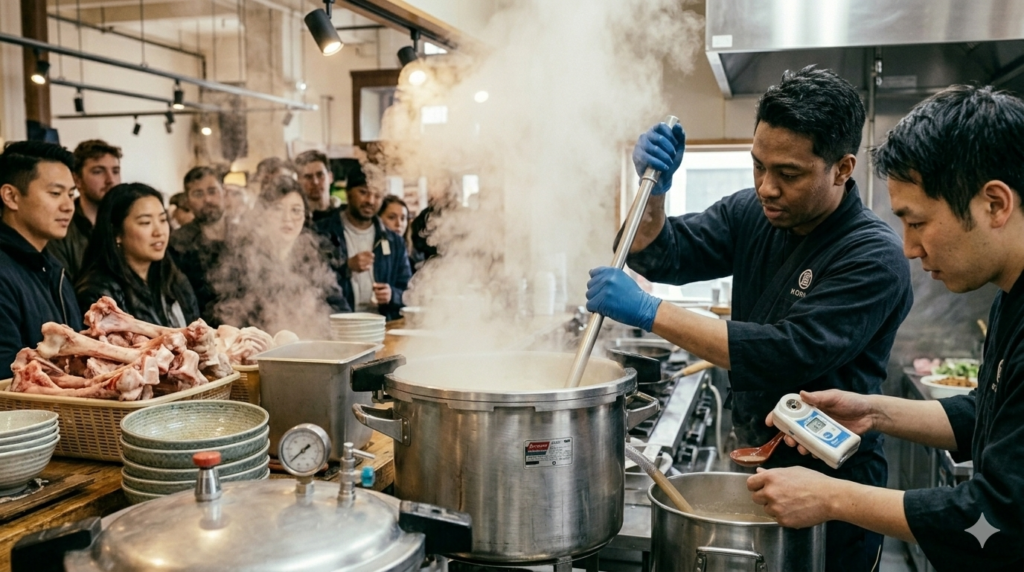
Prep with a Meiwa Seisakusho pressure stockpot takes five steps: “add ingredients → close the lid and heat → hold pressure on low heat → depressurize and cool → draw off through the transfer hose.” The amounts of bones and water, the pressurizing time and the valve operation can all be set as numbers, and the inner pot keeps solids off the bottom, so there is no need to keep stirring to prevent scorching. This makes the process easy to write down and to teach to staff with different languages and experience.
The owner of the chicken paitan shop “Menya Nojo” also says that because things are set by time and numbers rather than feel, it is easier to teach staff consistently when you want to hand over the work or open more shops (interview video with the owner, in Japanese).
Check the finished broth by its Brix (concentration) value too
Brix is a value showing the concentration of dissolved substances in a liquid, and is used as a guide to the strength of a broth. If each shop sets a target Brix and checks it by number as well as by tasting, differences between shops are noticed early. With a Meiwa Seisakusho pressure stockpot, broth concentration can be raised to a Brix of 12% or more (two-stage pressurizing; results in the company’s test environment).
Frequently asked questions
What is the ASME Code?
What documents does ASME compliance require?
Do Meiwa Seisakusho’s pressure stockpots carry the U-stamp?
Can local staff overseas make the same broth as the main shop?
Where can I consult about overseas expansion?
Summary: make checking the code and building procedures the first step of preparing a shop
When taking a ramen shop overseas, equipment that meets local regulations and a procedure that gives the same taste whoever cooks are as important as the recipe itself. Confirming the pressure stockpot’s code early together with the destination’s requirements, and turning prep into numbers such as bone and water amounts, pressurizing time and Brix, makes the opening easier to plan.
If the destination country or region and the capacity you need are decided, we can start from discussing specifications that fit the code.
▼ Overseas expansion, ASME, OEM and export inquiries
For customers outside Japan, Kitchen Techno, Meiwa Seisakusho’s sales agent, is your point of contact (English support available).
• Phone: Kitchen Techno +81-3-5285-3301 (10:00–17:00 Japan time, UTC+9)
https://pressurecooker.pro/en/contact-en/