Table of Contents (click to open)
- Conclusion: before passing price rises on to customers, change how you use up the bones
- Rising ingredient costs eat straight into profit
- The “extraction limit” of a conventional open stockpot
- High heat and pressure of about 120°C draw flavor from the core of the bone
- A worked example of the effect on food cost
- Less variation in taste, steadier prep
- Frequently asked questions
- First, test the effect with your own bones
Conclusion: before passing price rises on to customers, change how you use up the bones
Against rising pork and chicken bone prices, a pressure stockpot protects your margins by drawing more flavor from the same bones. Because it cooks at high heat and pressure of about 120°C, bones that stay hard in a regular stockpot soften until they break by hand, so you can use their flavor right down to the core. It is worth rethinking how you use the bones you buy before raising your prices.
Rising ingredient costs eat straight into profit
The purchase prices of pork and chicken bones, the foundation of ramen, are rising. Keep the price of a bowl unchanged and your food cost ratio rises while the profit left in the shop shrinks. Raise prices, though, and you may lose customers. Many owners are stuck in this dilemma.
Another way to protect profit is to change how you use the ingredients you buy. In conventional broth-making, bones that still hold flavor are often thrown away. If you can draw out that remaining flavor, the same ingredient budget yields more broth, and richer broth.
The “extraction limit” of a conventional open stockpot
When you make broth in an open stockpot, the temperature only reaches 100°C, no matter how high the flame. At 100°C it takes a long time for the hard collagen and marrow at the core of the bones to break down.
As a result, many kitchens throw away bones that could still give flavor at the end of each day’s prep. That is the same as putting cost that should have become broth into the trash. And adding more bones to make up for a thin broth only pushes ingredient costs higher.
High heat and pressure of about 120°C draw flavor from the core of the bone
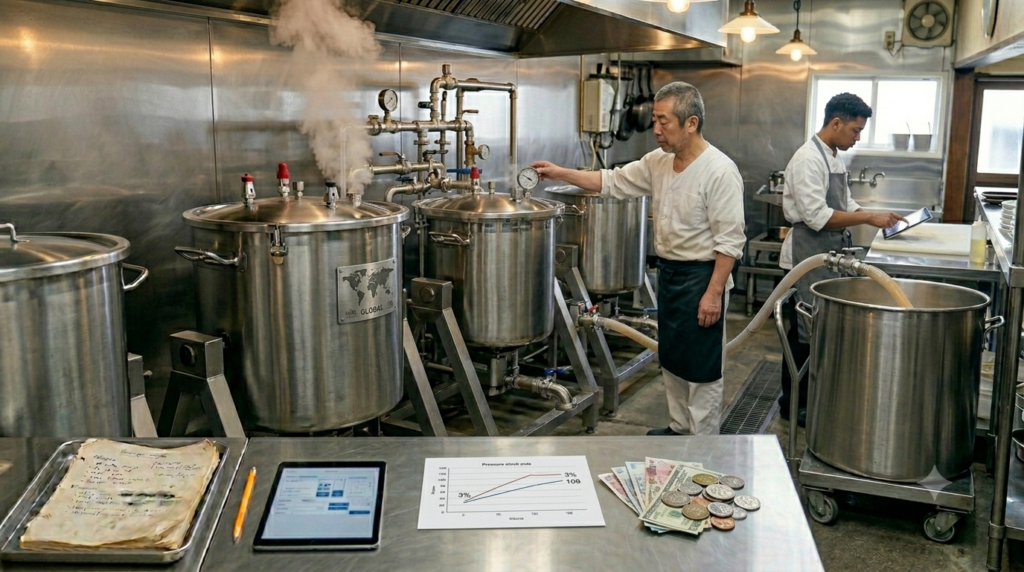
A pressure stockpot is a cooking vessel that seals the pot and applies pressure to raise the boiling point of water, keeping the inside at about 120°C. Pork knuckle bones that stay hard at 100°C soften at about 120°C until they break by hand.
Marrow and collagen dissolve well, and the broth emulsifies as it is drawn off through the transfer hose, so you get a rich broth. With Meiwa Seisakusho’s pressure stockpot, broth concentration can reach up to Brix 12% or more (two-stage pressurization). Simmering that took about 8–12 hours in a regular stockpot is finished in about 2 to 2.5 hours (Meiwa Seisakusho’s company results).
A worked example of the effect on food cost
Once you can use bones right down to the core, you may be able to make broth of the same concentration with fewer bones than before. How far you can go depends on the type of broth and the target concentration, so here is a worked example with clearly stated assumptions to show the effect on the food cost ratio.
Take a ramen shop with monthly sales of ¥3 million and ingredient costs of ¥1.05 million (a 35% food cost ratio), and suppose that by rethinking how it uses bones it cuts ingredient costs by ¥90,000 a month.
- Food cost ratio before: 35.0% (ingredients ¥1.05 million)
- Food cost ratio after: 32.0% (ingredients ¥960,000)
In this case the food cost ratio falls by 3 points, and the ¥90,000 a month—¥1.08 million a year—stays in the shop as profit. On top of that, gas costs fall because the heat can be kept low once pressure is reached: a shop that introduced the 90L model cut its monthly gas cost for tonkotsu broth from ¥150,000 to ¥70,000. Cooked bones crumble into small pieces, so their volume when discarded drops sharply, which also keeps disposal costs down.
Less variation in taste, steadier prep
Because a pressure stockpot cooks sealed, water hardly escapes into the air the way it does in an open stockpot. That reduces the need for a cook to keep topping up water to adjust the concentration.
With less variation from added water, the broth comes out at a similar concentration no matter who makes it. You keep ingredient costs down while protecting the consistency of flavor that matters so much to a ramen shop.
Frequently asked questions
Why does flavor stay in the bones in a regular stockpot?
How much shorter is cooking with a pressure stockpot?
How much can I reduce the amount of bones?
How much can the food cost ratio fall?
Does it reduce bone waste after cooking?
First, test the effect with your own bones
“Can we really use fewer bones with our tonkotsu recipe?” “At today’s purchase prices, how long until it pays for itself?” The quickest way to answer questions like these is to try it on the actual unit.
Have your monthly bone purchase volume and target broth concentration (Brix) at hand and get in touch. We will help you estimate ingredient and gas costs with Meiwa Seisakusho’s pressure stockpot.
▼ Cost estimates, test cooking and overseas inquiries
For customers outside Japan, Kitchen Techno, Meiwa Seisakusho’s sales agent, is your point of contact (English support available). Test cooking with your own recipe is available at the test kitchens in Tokyo and Osaka (reservation required).
• Phone: Kitchen Techno +81-3-5285-3301 (10:00–17:00 Japan time, UTC+9)
https://pressurecooker.pro/en/contact-en/